
We have all been there. You walk into the tire shop, expecting to pay $600 for a set of new tires, just like you did for your old Honda Civic.
Then the clerk hands you the quote: $1,400.
You stare at the paper. Then you look at the rack of “standard” tires that cost half as much. They look exactly the same. They are round, black, and made of rubber. So, the big question pops into your head:
“Can I just put regular tires on my electric car and save $700?”
The short answer is yes, they will physically fit. The long answer is that it might be the most expensive mistake you make with your car.
⚠️ Quick Answer: Can You Use Regular Tires on an EV?
Technically, yes, regular tires will fit an electric car if the rim size matches. However, automotive engineers strongly advise against it. Regular tires are not designed to handle the extra weight (battery pack) and instant torque of an EV. Using them can result in a 10-15% loss of range, significantly increased cabin noise, rapid tread wear, and a higher risk of tire blowouts due to insufficient Load Index ratings.
It’s Not Just Marketing Hype: The “EV Difference”
Many new owners think “EV-Specific Tires” are just a marketing gimmick to charge more money. It is easy to be skeptical when the price difference is so huge.
But unlike gas cars, Electric Vehicles (EVs) present a unique engineering challenge that standard rubber simply isn’t built to solve. If you switch to a budget tire, you break the “Golden Triangle” of performance:
🔹 What makes an EV tire special?
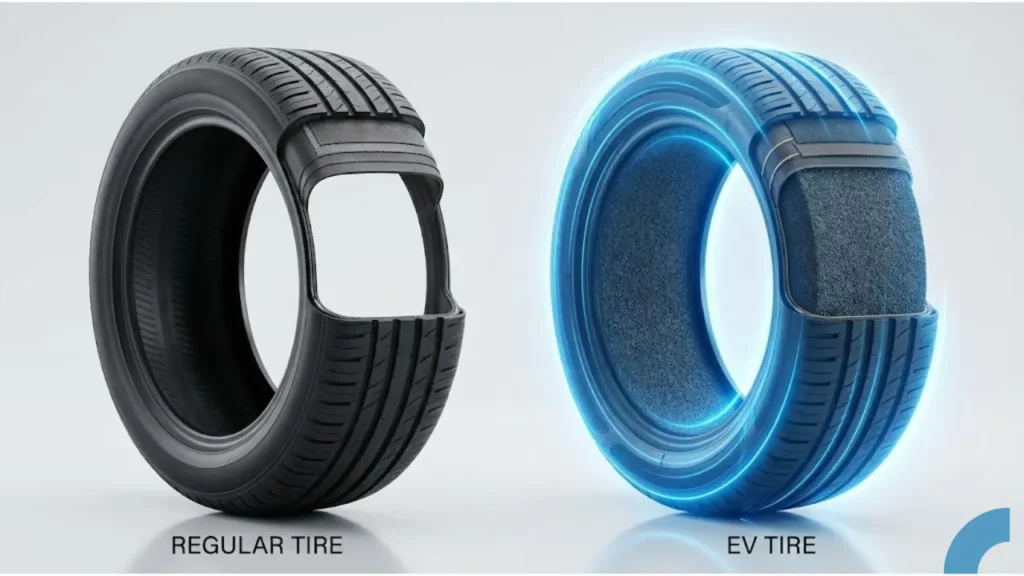
Premium manufacturers like Michelin and Continental use specialized rubber compounds, reinforced sidewalls, and internal acoustic foam.
See the difference for yourself in our breakdown of the Best Tires for Tesla Model Y & 3 (Quiet & Efficient Choices) to understand what you are actually paying for.
Before you swipe your card for those cheaper tires, you need to understand the three critical risks you are taking. Let’s break down the physics.
The 3 Penalties of Using “Normal” Tires
When you swap specialized EV rubber for a generic $150 tire, you aren’t just saving money—you are downgrading your vehicle’s performance in three critical ways.
The Safety Risk: Heavy Weight & Blowouts
This is the most dangerous factor. Electric cars are heavy. A Tesla Model Y weighs about 1,000 lbs more than a Honda CR-V because of the massive battery pack.
Standard tires (marked “SL” for Standard Load) are not built to support this constant weight, especially while cornering. EV-specific tires come with an “XL” (Extra Load) or the new “HL” (High Load) rating.
(Source: Continental Tires Engineering Guide regarding HL vs. XL load capacities.)
The Range Hit: Losing 10-15% Efficiency
Regular tires are “sticky.” They have high rolling resistance, meaning they grab the asphalt aggressively. While this is fine for a gas car, it kills an EV’s battery efficiency.
EV tires are designed to glide. Switching to a standard tire increases drag. You might save $200 at the shop, but you will lose 30-40 miles of range per charge.
💡 Think of it this way:
You know how cold weather kills your battery? Installing high-resistance tires is like driving in winter conditions all year round.
Read our Real-World Test on EV Range Loss to see how much range creates “Range Anxiety.”
The “Drone” Noise
In a gas car, the engine noise drowns out the sound of the tires rolling on the pavement. In an EV, the engine is silent. This makes tire noise (“road drone”) incredibly obvious and annoying.
Premium EV tires (like Michelin Pilot Sport EV) have a layer of polyurethane acoustic foam glued inside to absorb vibration. Regular tires are hollow. Without that foam, your quiet luxury cabin will sound like a budget economy car on the highway.
The Math: Are You Actually Saving Money?
Let’s do the math. Imagine you plan to drive 40,000 miles. You have two choices: A premium EV tire ($300 each) or a budget standard tire ($150 each).
| Cost Factor | Premium EV Tire | Budget Standard Tire |
|---|---|---|
| Upfront Cost (4 Tires) | $1,200 | $600 (You save $600!) |
| Lifespan | 40,000 miles | 20,000 miles (Wears 2x faster) |
| Replacement Need | None | Need 2nd Set ($600) |
| Energy Loss (Cost) | $0 | +$250 (Electricity) |
| TOTAL COST (40k Miles) | $1,200 | $1,450 + Headaches |
The Verdict: The “cheap” tires actually cost you $250 more in the long run because you have to buy them twice and pay for extra electricity due to higher rolling resistance.
🔋 Time is Money, Too
Using inefficient tires doesn’t just cost money; it costs time. Because your range drops by ~10%, you will need to stop at Superchargers more frequently on road trips.
If you already feel like charging takes too long, don’t make it worse with bad tires.
(Read more: Why Is Electric Car Charging So Slow? Factors You Can Control).
When is it OK to Use Regular Tires?
We generally advise against it, but there are two specific scenarios where installing standard tires might make sense:
- 1. Lease Returns: If your lease is ending next month and the dealership charges $400 per tire for wear and tear, buying a cheaper set of “standard” tires (that meet the speed/load rating) can save you money. You won’t be driving the car long enough to notice the range loss.
- 2. Emergency Situations: If you get a blowout in a rural area and the local shop only has a standard tire that fits your rim, use it to get home. Safety comes first. Just replace it with a proper EV tire when you can.
🏁 The Final Verdict
While you can physically mount regular tires on an EV, you shouldn’t. The 15% range loss and rapid tread wear mean you will end up paying more in the long run.
For independent test data comparing stopping distances and efficiency, check out Tire Rack’s Analysis on EV vs. Conventional Tires.
Frequently Asked Questions
Look at the sidewall for the Load Index (a number like 98, 104, etc.) and the rating. EV owners should look for “XL” (Extra Load) or the new “HL” (High Load) marking. Never go below the number listed on your driver’s door jamb.
Absolutely not. Mixing tire types causes uneven grip, unpredictable handling, and can confuse your traction control system. Always replace tires in sets of 4, or at least in pairs (front/rear).
Using non-approved tires usually won’t void your car’s main warranty, but it will void the tire manufacturer’s mileage warranty because the heavy EV will wear them out prematurely.
Not Professional Advice: The content on GreenMount Motors is for informational purposes only. Always consult your vehicle owner’s manual or a certified tire professional before making changes. Incorrect tire selection can lead to safety hazards.
Affiliate Disclosure: This post may contain affiliate links. If you make a purchase through these links, we may earn a small commission at no extra cost to you.