
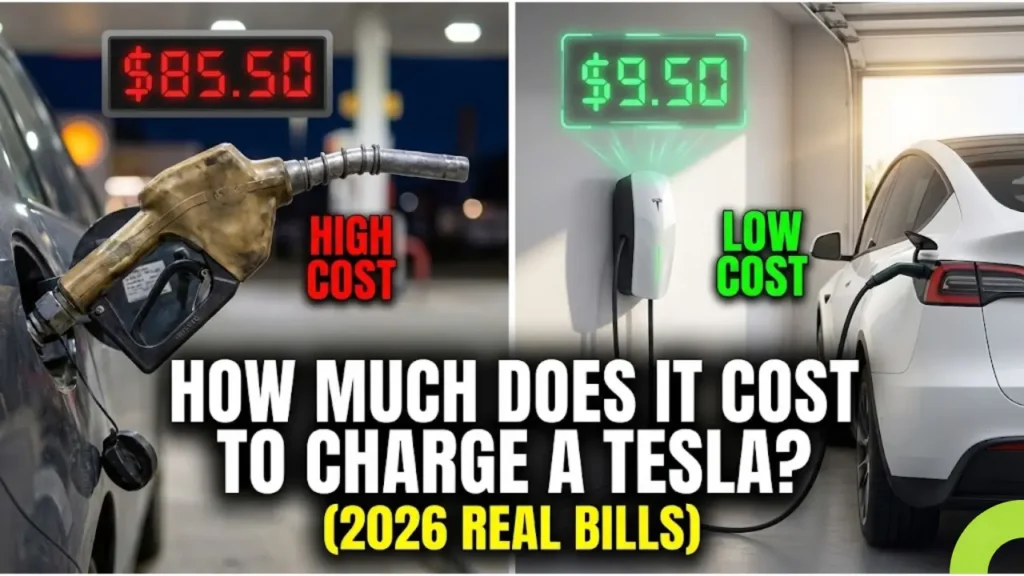
The last time you visited a gas station, you probably stared at the pump screen as the numbers ticked up… $40… $50… $70. It hurts every time.
When you switch to a Tesla, that pain disappears. There is no pump, no smell of gasoline, and no receipt handed to you. But electricity isn’t free. This leaves many new owners wondering: “Am I actually saving money, or is my electric bill about to explode?”
Let’s skip the fluff and look at the real numbers.
⚡ Quick Answer: Cost to Charge a Tesla (2025 Estimates)
The cost to fully charge a Tesla depends heavily on where you charge.
🏠 At Home: It costs between $13 and $18 for a full charge (based on the US avg of $0.16/kWh). This is the cheapest method.
🔌 Supercharger: It costs between $25 and $35 for a full charge (avg $0.35 – $0.50/kWh). While faster, it is 2-3x more expensive than home charging.
The “Full Tank” Comparison
To understand the savings, we need to compare a “Full Fill-Up” of a Tesla Model Y Long Range (75 kWh battery) vs. a similar gas SUV (15-gallon tank).
| Refueling Method | Cost to Fill (0-100%) | Range You Get |
|---|---|---|
| 🏠 Tesla Home Charging (Off-Peak Rates) |
$14.50 | 310-330 miles |
| ⚡ Tesla Supercharger (Public Fast Charging) |
$32.00 | 310-330 miles |
| ⛽ Gas SUV (Example) (@ $3.50/gallon) |
$52.50 | 350-400 miles |
1. The Home Economics (The Cheapest Way)
90% of EV charging happens at home. This is where the magic “savings” happen. To calculate your exact cost, you need to understand one boring but important unit: the Kilowatt-hour (kWh).
Think of kWh as “Gallons” of electricity.
Think of the Battery Pack Size as the “Fuel Tank Size.”
For example, a Tesla Model Y Long Range has a battery pack of roughly 75 kWh (usable capacity). If you live in a state like Texas or Florida where electricity is cheap (~$0.14/kWh), a full charge costs just $10.50.
While charging at home is cheap, doing it incorrectly can be dangerous. Never use a standard household extension cord to reach your car. It causes voltage drop (wasting money) and fire risks.
Check our safety guide on Extension Cord EV Charging Safety: Do’s and Don’ts before plugging in.
2. The Supercharger: Paying for Speed
While home charging is like brewing coffee in your kitchen ($0.50), using a Supercharger is like buying a latte at Starbucks ($6.00). You are paying for the convenience and speed.
On average, Tesla Superchargers cost about $0.25 to $0.50 per kWh. That is roughly 2x to 3x more expensive than charging at home.
Tesla uses “Tiered Pricing” in many locations to reduce congestion. If you plug in during rush hour, you pay a premium.
-
ON-PEAK (11 AM – 9 PM)
Price: ~$0.45 – $0.58 per kWh
Cost for full charge: $35+ -
OFF-PEAK (9 PM – 11 AM)
Price: ~$0.20 – $0.35 per kWh
Cost for full charge: $18 – $25
Strategy: If you are on a road trip, try to charge early in the morning or late at night. You can save nearly 50% on your bill just by avoiding the 5 PM rush.
⚠️ Are you getting the speed you paid for?
You are paying premium rates for “Supercharging,” but sometimes the car charges slowly. Cold batteries or sharing a stall with another car can throttle your speed.
Don’t waste money sitting at a charger longer than necessary. Learn what kills your charging speed in our guide: Why Is Electric Car Charging Slow? (Factors You Can Control).
🚫 The “Idle Fee” Nightmare ($1.00/min)
This is where new owners get burned. A Supercharger is for charging, not parking.
If you leave your car plugged in after it has reached 100% (or your set limit), Tesla charges you an Idle Fee.
- Standard Fee: $0.50 per minute.
- Congestion Fee: $1.00 per minute (if the station is full).
Example: You go grab lunch and return 20 minutes late. You just added $20 to your bill for no electricity at all. Move your car immediately when the app notifies you!
2. The Supercharger: Paying for Speed
While home charging is like brewing coffee in your kitchen ($0.50), using a Supercharger is like buying a latte at Starbucks ($6.00). You are paying for the convenience and speed.
On average, Tesla Superchargers cost about $0.25 to $0.50 per kWh. That is roughly 2x to 3x more expensive than charging at home.
Tesla uses “Tiered Pricing” in many locations to reduce congestion. If you plug in during rush hour, you pay a premium.
-
ON-PEAK (11 AM – 9 PM)
Price: ~$0.45 – $0.58 per kWh
Cost for full charge: $35+ -
OFF-PEAK (9 PM – 11 AM)
Price: ~$0.20 – $0.35 per kWh
Cost for full charge: $18 – $25
Strategy: If you are on a road trip, try to charge early in the morning or late at night. You can save nearly 50% on your bill just by avoiding the 5 PM rush.
⚠️ Are you getting the speed you paid for?
You are paying premium rates for “Supercharging,” but sometimes the car charges slowly. Cold batteries or sharing a stall with another car can throttle your speed.
Don’t waste money sitting at a charger longer than necessary. Learn what kills your charging speed in our guide: Why Is Electric Car Charging Slow? (Factors You Can Control).
🚫 The “Idle Fee” Nightmare ($1.00/min)
This is where new owners get burned. A Supercharger is for charging, not parking.
If you leave your car plugged in after it has reached 100% (or your set limit), Tesla charges you an Idle Fee.
- Standard Fee: $0.50 per minute.
- Congestion Fee: $1.00 per minute (if the station is full).
Example: You go grab lunch and return 20 minutes late. You just added $20 to your bill for no electricity at all. Move your car immediately when the app notifies you!
How to Lower Your Bill Even Further
Want to pay even less? You can hack your electricity bill. Most utility companies offer special incentives for EV owners that standard customers don’t know about.
📉 3 Ways to Charge for Pennies
After crunching the numbers, the average Tesla owner saves between $800 and $1,200 per year compared to driving a gas car.
While Supercharging is expensive, 90% of your driving will likely be powered by cheap home electricity. It’s not just cleaner; it’s mathematically smarter.
Verify the official fuel economy data at U.S. Department of Energy (FuelEconomy.gov).
Frequently Asked Questions (FAQs)
For most people, no. Tesla ended the “Free Unlimited Supercharging” program for new cars back in 2017. However, you may get free charging credits through referral programs or promotional offers when buying a new vehicle.
Surprisingly, 220V (Level 2) is cheaper. While electricity costs the same, charging at 110V takes days, meaning the car’s computer stays awake longer, wasting energy on “overhead.” Faster charging is more efficient.
It is very accurate for Superchargers because Tesla controls the prices. However, it cannot predict what you pay at home unless you manually enter your utility rate in the Tesla App settings.
Estimates Only: The costs mentioned in this article are national averages (based on U.S. EIA data). Your actual charging cost will vary based on your local electricity rates, battery condition, driving habits, and weather.
External Data: Electricity rate averages sourced from the U.S. Energy Information Administration (EIA).
Pingback: Tesla Battery Replacement Cost (2026): The Real Price of a New Pack - greenmountmotors.com
Pingback: NEMA 14-50 Outlet Guide: Best EV Charger Setup? (Cost & Safety) - greenmountmotors.com
Pingback: Tesla Model 3 vs Model Y (2026): Which One Fits Your Life? - greenmountmotors.com
Pingback: Do Electric Cars Need Oil? (The Myth vs. Maintenance Reality) - greenmountmotors.com
Pingback: Cheapest Electric Cars 2026: 5 Best EVs Ranked by "Real" Price - greenmountmotors.com
Pingback: What is Tesla Sentry Mode? (2026 Guide): Battery Drain & Setup - greenmountmotors.com
Pingback: Tesla Camp Mode Guide 2026: Battery Drain, Bed Setup & Tips - greenmountmotors.com