
You pull into your driveway, grab the charging cable, and plug it in. Usually, you hear a satisfying “Click-Clack” as the latch locks into place.
But today? Nothing. Or worse, the car dashboard says “Unable to Charge” or “Check Charge Port.”
Before you panic and call a tow truck, take a flashlight and look inside the port. Chances are, a simple dead leaf, some lint, or a bit of dirt is blocking the connection. Cleaning it is easy, but if you do it wrong, you could fry your car’s onboard charger—or yourself.
🧽 Quick Answer: How to Clean an EV Charging Port Safely
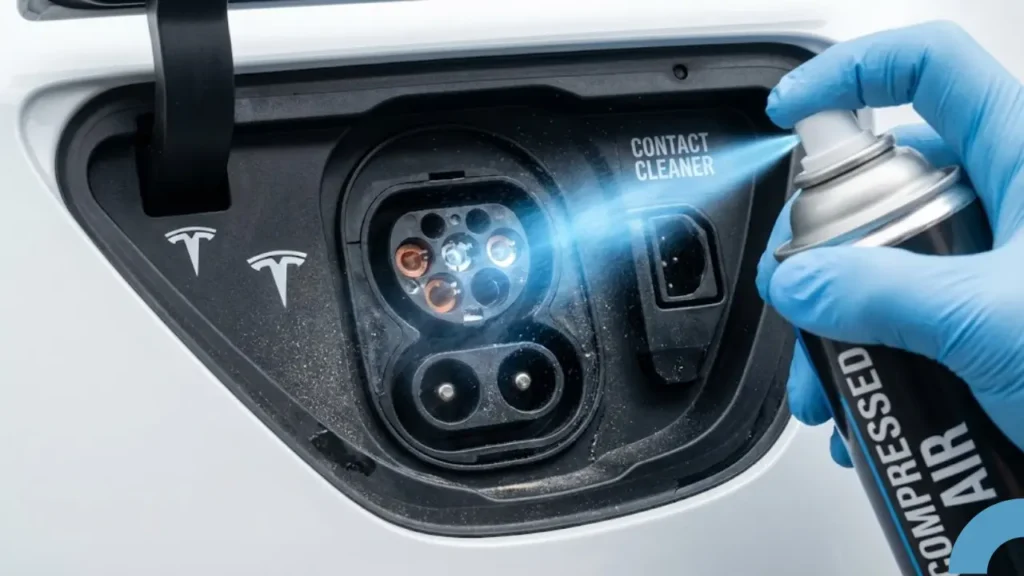
To clean an electric vehicle charging port safely, first ensure the car is in “Sleep Mode” and not charging. Use canned compressed air to blow out loose debris. For stuck dirt or corrosion, use a plastic dental pick (never metal) and spray with a quick-drying Electrical Contact Cleaner (like CRC). Never use water, cotton swabs, or conductive tools inside the port.
Signs Your Charge Port Needs a Bath
Your EV’s charging port is exposed to the elements every time you open that flap. Over time, dust, pollen, and spiderwebs accumulate. How do you know it’s time to clean?
- The “Latch” Failure: The locking pin cannot extend fully because dirt is blocking the hole.
- Overheating Handles: Dirt creates electrical resistance, which generates heat.
- The “Red Ring of Death”: The car detects a poor connection and refuses to accept power.
If your Tesla or EV is flashing a red, amber, or yellow light at the port, it’s trying to tell you specific error codes.
Before you start cleaning, check our guide on Tesla Charge Port Light Meanings to rule out internal system failures.
Stop! Put the Screwdriver Down
The biggest mistake people make is grabbing whatever is in the toolbox. Remember, you are cleaning high-voltage connectors. Using a metal object can damage the specialized plating on the pins, cause arcing, or worse.
| ❌ DANGEROUS TOOLS | ✅ SAFE TOOLS |
|---|---|
|
✖ Metal Screwdrivers
Can scratch pins & cause shorts. ✖ Cotton Swabs (Q-Tips)
Fibers get stuck and can burn. ✖ Water / Soap
Never put liquids in electrical ports. ✖ Sandpaper
Ruins the conductive silver plating. |
✔ Plastic Dental Picks
Non-conductive & precise. ✔ Compressed Air
Blows out loose dust safely. ✔ Contact Cleaner
Specific chemical that dries instantly. ✔ Flashlight
To see deep inside the pins. |
💡 Why does “Lint” matter?
It seems harmless, but a layer of dust or cotton fibers acts as an insulator. This increases Electrical Resistance.
When resistance goes up, heat goes up. Your car’s computer senses this heat and intentionally slows down the charging speed to prevent melting.
Is your car taking forever to charge even with a clean port? Read our guide on Why Is Electric Car Charging So Slow? to find other culprits.
Never spray regular WD-40 inside your charge port. It is oil-based. It will trap dust and create a sticky “sludge” that is impossible to clean out later. Only use “QD Electronic Cleaner” or similar products labeled for sensitive electronics.
The 10-Minute Cleaning Routine
Ready to clean? Follow this exact order. Do not skip the drying step.
Safety first. Ensure your car is unplugged and in “Sleep Mode.” If you want to be extra safe (especially for wall connectors), flip the breaker switch in your garage to OFF.
Take your can of compressed air. Hold it upright (do not shake it, or freezing liquid will spray out).
Give the port 3-4 short blasts from different angles. This dislodges loose dust, sand, and dry leaves without you touching anything.
Use your flashlight to look inside. Do you see a piece of lint or a dead bug stuck deep inside a pinhole?
Gently use the Plastic Dental Pick to hook it and pull it out. Be extremely gentle. Do not scrape the metal pins inside the holes.
If there is sticky residue or corrosion (green/white powder), use the Electrical Contact Cleaner.
- Spray the cleaner onto the plastic pick, not directly into the port (to avoid flooding it).
- Gently wipe the plastic areas around the pins.
- Note: These cleaners evaporate in seconds and leave zero residue.
*Ensure your cleaner is labeled “Plastic Safe.” See CRC QD Electronic Cleaner Specs for reference on what safe chemicals look like.
Even though contact cleaner dries fast, give it 5 minutes to fully evaporate before introducing high-voltage electricity.
🔌 Don’t Forget the Handle!
You just cleaned the car’s port, but what about the charger plug? If you drop your charging cable on the garage floor, it picks up dirt, oil, and sand.
The Fix: Inspect the pins inside the charging handle. If they look black or grimy, use the same “Contact Cleaner + Compressed Air” method to clean them. A dirty handle will dirty your clean car port instantly.
Prevention: Keep It Clean for Good
Cleaning is annoying. Prevention is easy. Here is how to stop dirt from getting in there in the first place.
Read our Guide on Long-Term Parking Safety.
Frequently Asked Questions (FAQs)
Yes, but be careful. High-percentage alcohol (90%+) is safe as a solvent, but specialized “Contact Cleaner” is better because it is designed to remove oxidation and dries faster without leaving streaks.
A vacuum is safer than blowing with your mouth (which adds moisture), but it is often too weak to pull out stuck debris. Compressed air is much more effective for tight crevices.
If cleaning doesn’t work, the motorized locking mechanism might be broken. Do not force it. Most EVs have a “Manual Release Cable” in the trunk. Check your owner’s manual for its location.
Safety Warning: Cleaning EV charging ports involves high-voltage components. The information provided in this guide is for educational purposes only. Always disconnect power sources before cleaning. If you are unsure or uncomfortable, contact a certified EV technician. GreenMount Motors is not responsible for any damage or injury.
Affiliate Disclosure: This post may contain affiliate links (e.g., for cleaning products). We may earn a small commission at no extra cost to you.
Pingback: Tesla Wind Noise Reduction Kit Review: Snake Oil or Worth It? (2026) - greenmountmotors.com