
When you buy a gas car, you worry about the transmission blowing up. When you buy a Tesla, you worry about one thing: The Battery.
It is the single most expensive component in the vehicle, costing anywhere from $12,000 to $20,000 to replace. Naturally, owners want to know: “Will this battery die before I finish paying off the loan?”
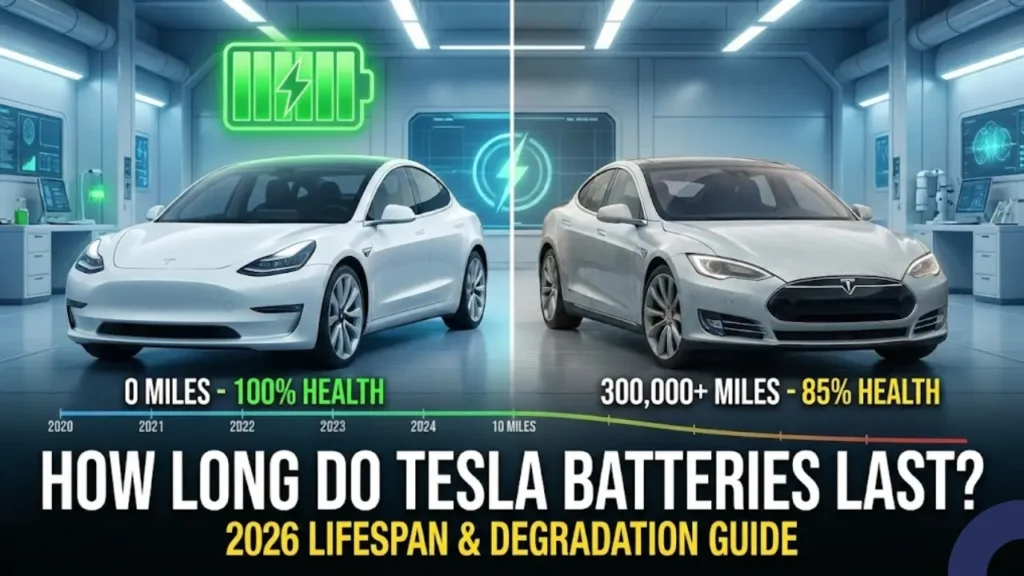
According to Tesla’s official impact reports and real-world data, modern Tesla batteries are designed to last between 300,000 and 500,000 miles (approx. 1,500 battery cycles). For the average American driver (13,500 miles/year), this equates to a lifespan of 22 to 37 years before the battery needs replacement.
Estimated Lifespan by Model (2026 Data)
Not all Teslas are created equal. The lifespan depends heavily on the battery chemistry (which we will cover in Step 2) and the size of the pack. Here is the breakdown:
| Model | Est. Mileage Limit | Est. Years |
|---|---|---|
| Model 3 (RWD / LFP) | 500,000+ mi | 25+ Years |
| Model 3 / Y (Long Range) | 300,000 mi | 20 Years |
| Model S / X (Plaid) | 400,000 mi | 25 Years |
| Older Model S (2012-2015) | 200,000 mi | 15 Years |
The “Million Mile Battery” Myth vs. Reality
You may have heard Elon Musk talking about a “Million Mile Battery.” While this technology exists in labs and is being rolled out in commercial Tesla Semis, it is not standard in every consumer car yet.
🚨 The Harsh Truth: The Car Dies First
Here is the irony: The battery is now so good that it will likely outlast the rest of the car.
Driving 300,000 miles takes roughly 22 years. By then, the suspension will be shot, the seats will be torn, the touchscreen might fail, and the door handles might break. In 2026, you are more likely to replace the car because the body is worn out, not because the battery is dead.
However, failures do happen. If you fall into the unlucky 1% and need a replacement out of warranty, the cost can be shocking.
Check the exact price list here:
Tesla Battery Replacement Cost: What to Expect in 2026.
So, the battery lasts a long time. But why does the cheaper Model 3 RWD actually last longer than the expensive Model S? The secret lies in the Chemistry.
Step 2: Know Your Chemistry (LFP vs. Nickel)
This is the most critical part of this guide. In 2026, Tesla uses two completely different types of battery chemistries depending on which model you buy. Treating one like the other can actually harm your battery lifespan.
Lithium Iron Phosphate. Found in Standard Range Model 3 & Model Y.
| Cycle Life: | 3,000+ Cycles |
| Daily Charge: | Charge to 100% |
| Pros: | Lasts 2x longer, safer, cheaper. |
Nickel Cobalt (NCA/NCM). Found in Long Range & Performance Models.
| Cycle Life: | 1,000 – 1,500 Cycles |
| Daily Charge: | Limit to 80% |
| Pros: | More range, lighter, works better in cold. |
Why the 100% vs. 80% Rule?
This confuses everyone. Here is the simple science:
- Nickel Batteries (Long Range): They are like a rubber band. Stretching them to 100% creates “tension” (voltage stress) inside the cells. Doing this daily causes micro-cracks, killing the battery faster. That’s why Tesla says “Stop at 80%.”
- LFP Batteries (Standard Range): They are chemically more stable and relaxed. However, they have a “flat voltage curve,” meaning the car’s computer struggles to know if it has 20% or 40% left. Charging to 100% acts like a “reset button” for the calculator. If you don’t hit 100% weekly, your range estimate might drift and become inaccurate.
Don’t guess. Go to your car’s touchscreen right now:
Tap Controls > Software > Additional Vehicle Information.
Look for “High Voltage Battery Type”. If it says Lithium Iron Phosphate, you have an LFP battery (Charge to 100%!). If it doesn’t say that, you have Nickel (Limit to 80%).
Step 3: The “Degradation Curve” (Don’t Panic!)
Here is a scenario that scares every new Tesla owner: You buy a Model Y with 310 miles of range. Six months later, it shows 300 miles. You panic and think, “At this rate, my battery will be dead in 5 years!”
Stop right there. Battery degradation is not linear. It follows a specific curve that looks more like a “hockey stick.”
-
Phase 1: The “Break-In” Drop (0 – 20,000 miles)
This is where you lose the most range instantly. It is normal to lose roughly 5% to 8% of your capacity in the first year as the chemical structure stabilizes. This is NOT a defect.
-
Phase 2: The “Long Plateau” (20,000 – 150,000+ miles)
After the initial drop, the degradation slows down massively. You might only lose 1% range for every additional 30,000 miles driven. The battery effectively “stabilizes” for a decade.
What Does the Data Say?
Tesla collects data from millions of cars on the road. In their official 2025 Impact Report, they revealed exactly how much battery is left after high mileage.
Most Teslas retain nearly 90% of their original range even after driving the distance of 8 trips around the Earth.
Translation for the Real World:
If you buy a Model 3 with 300 miles of range today, and you drive it for 15 years (200k miles), it will likely still have roughly 264 miles of range left. That is still more than enough for almost any road trip.
💡 Want to beat the curve?
While degradation is natural, how you charge accelerates it. Using Superchargers every day heats up the battery and hurts it.
See the cost difference and health benefits of home charging here:
Home Charging vs. Supercharging: Cost & Battery Health.
Step 4: How to Make Your Battery Last Forever
You cannot stop degradation completely, but you can slow it down significantly. If you treat your battery right, it could easily last 500,000 miles. If you abuse it, you might kill it in 150,000.
- The 20-80 Rule: Try to keep the battery between 20% and 80% for daily driving (Nickel batteries only).
- ABC (Always Be Charging): Keep the car plugged in when parked at home. The system manages the health automatically.
- Precondition: Use the app to warm up the battery before driving in winter.
- 0% State of Charge: Never leave the car sitting at 0% or 100% for days. This stresses the cells.
- Constant Supercharging: Only use fast chargers for road trips, not for daily fueling. Heat kills batteries.
- Launch Mode: Doing 0-60 launches repeatedly overheats the pack instantly.
The Safety Net: Tesla’s Warranty Explained
Still worried? Remember that you have a massive safety net. Every new Tesla comes with a federally mandated battery warranty that covers you if the battery fails prematurely.
🛡️ The 8-Year Guarantee
If your battery capacity drops below 70% retention within the warranty period, Tesla will replace or repair it for FREE.
• Model 3 / Y (Long Range): 8 Years or 120,000 miles
• Model S / X: 8 Years or 150,000 miles
The Final Verdict
So, how long do Tesla batteries last? Longer than you will likely own the car.
With modern thermal management and LFP chemistry, the days of worrying about battery failure are largely over. Drive it, enjoy it, and don’t obsess over every 1% drop in range. The car is built to handle it.
Frequently Asked Questions (FAQs)
If you are out of warranty, a full battery replacement typically costs between $13,000 and $20,000 (including labor) depending on the model. However, module repairs can be cheaper ($5,000 – $7,000) at third-party shops.
It depends on your battery type. If you have an LFP battery (Model 3 RWD), yes, you should charge to 100% at least once a week. If you have a Nickel (NCA/NCM) battery (Long Range/Performance), you should limit daily charging to 80% to preserve lifespan.
Tesla batteries are 100% recyclable. Once they are too degraded for a car, they are either recycled for raw materials (Lithium, Cobalt, Nickel) or repurposed for stationary energy storage (Powerwalls).
⚠️ Technical Disclaimer: Battery degradation estimates are based on average fleet data provided by Tesla and third-party analytics firms (like Recurrent Auto). Individual results may vary based on climate, charging habits, and driving style. Always consult your owner’s manual for specific charging recommendations.