
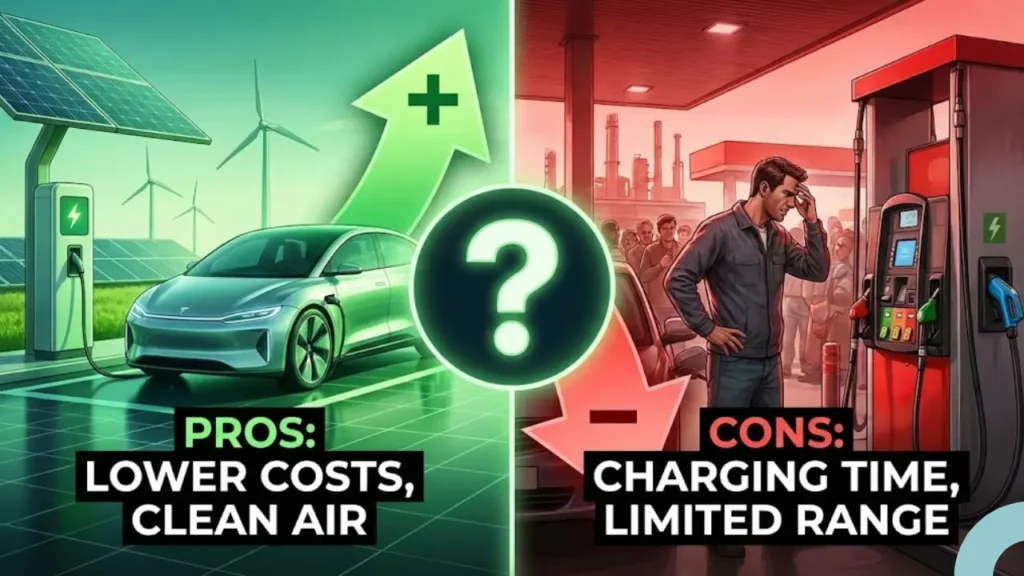
In 2026, the question is no longer “Does the technology work?” We know it works. The question has shifted to: “Does the math make sense for my wallet?”
Switching to an electric car is not just about changing what you put in the tank; it is a complete overhaul of your financial relationship with your vehicle. While you will say goodbye to gas stations, you might say hello to higher insurance premiums.
Before you make the switch, you need to look at the Total Cost of Ownership (TCO), not just the monthly payment. Let’s break down the financial wins and losses.
The Money Talk: Savings vs. Expenses
- Fuel Savings: Electricity is roughly 60-70% cheaper than gasoline per mile.
- Minimal Maintenance: No oil changes, spark plugs, or timing belts.
- Government Handouts: Access to the $7,500 Federal Tax Credit.
- Upfront Cost: EVs still cost ~10% more than comparable gas cars upfront.
- Insurance Spikes: Premiums are 15-20% higher due to repair complexity.
- Depreciation: EV resale values can fluctuate wildly based on battery health.
1. The “Fuel” Math: Electricity vs. Gas
This is the biggest selling point. In 2026, the national average for a gallon of gas is hovering around $3.50, while the average residential electricity rate is $0.16 per kWh.
According to the U.S. Department of Energy, driving an electric car is equivalent to paying $1.20 per gallon of gasoline. Over 5 years of ownership, the average driver saves roughly $4,600 on fuel alone.
2. The Hidden “Insurance” Tax
Here is the ugly truth that dealerships rarely mention: EVs are expensive to insure.
Why? Because if an electric car gets into a minor accident that damages the battery pack casing, insurance companies often declare the car a “Total Loss” rather than risk a fire or expensive repair. Plus, specialized EV mechanics charge higher labor rates.
| Expense (Yearly) | Gas Car (Toyota Camry) | Electric Car (Tesla Model 3) | Winner |
|---|---|---|---|
| Fuel / Energy | $1,850 | $650 | ✅ EV |
| Insurance | $1,400 | $1,950 | ✅ Gas |
| Maintenance | $600 | $200 | ✅ EV |
| Net Yearly Cost | $3,850 | $2,800 | EV Saves $1,050/yr |
💡 Offset the Upfront Cost
The higher upfront sticker price of an EV can be completely neutralized if you qualify for government incentives. The $7,500 instant discount effectively wipes out the “EV Premium.”
Check if your income and vehicle choice qualify in our guide:
Federal EV Tax Credit 2026: The Complete Guide.
So, financially, the EV wins in the long run if you keep it for more than 3 years. But money isn’t everything. What is it actually like to live with one every day? That brings us to the driving experience.
Step 2: The Daily Drive (Fun vs. Frustration)
Forget the money for a second. What does it actually feel like to live with an electric car? The experience is a mix of “Future Tech Luxury” and “Logistical Planning.”
Instant Torque: Gas cars need to downshift and rev up. EVs go instantly. Even a budget EV feels faster than a sports car at traffic lights. It makes merging onto highways effortless and fun.
The “Broken Charger” Reality: Unlike gas stations, public chargers are often offline or broken. If you drive non-Tesla EVs, relying on third-party networks (like Electrify America) can be frustrating.
The Secret Weapon: One-Pedal Driving
This is a feature you don’t know you need until you try it. When you lift your foot off the accelerator, the electric motor turns into a generator to recharge the battery (Regenerative Braking).
This slows the car down significantly without touching the brake pedal. In stop-and-go traffic, it is a game-changer. You can drive for miles without ever moving your foot to the brake. It reduces fatigue massively.
Scenario: A 400-Mile Road Trip
-
⛽ Gas Car: Stop once for 5 minutes. Grab a coffee. Done.
Total Added Time: 10 mins. -
🔋 Electric Car: Stop twice for 20-30 minutes each. You must plan your route around chargers. If a charger is full, you wait.
Total Added Time: 45-60 mins.
Verdict: If you road trip constantly, a Hybrid might still be better. For EVs, planning is mandatory.
Before buying an EV, look at the charging map in your area. Don’t guess. Use PlugShare to see real user reviews of charging stations near your home and office. If the chargers near you have a “Score” below 8/10, be careful.
🏠 The “Golden Rule” of Ownership
Can you charge at home?
If the answer is YES, an EV is more convenient than a gas car (you start every day with a full tank).
If the answer is NO (apartment dwellers), owning an EV can become a chore. Relying 100% on public charging is expensive and time-consuming.
Step 3: The Technical Reality (Safety, Weather & Tires)
Beyond the driving feel, there are physics at play that make owning an EV fundamentally different from a gas car. Some of these physics save your life, while others eat your wallet.
EVs store their heavy battery packs in the floor. This gives them an incredibly low center of gravity.
It makes them extremely difficult to rollover in an accident. Plus, the lack of a heavy engine block in the front creates a massive “crumple zone” to protect passengers.
An electric motor has roughly 20 moving parts. A gas engine has 2,000+.
Fewer parts mean fewer things to break. No transmission failures, no head gasket leaks, and no muffler rust.
Want to know exactly what maintenance is left? It’s mostly just windshield wipers. Read our breakdown here: Do Electric Cars Need Oil? (Maintenance Guide).
The “Kryptonite”: Cold Weather
If you live in Florida, skip this section. If you live in Chicago or Canada, read this twice.
❄️ The Winter Range Penalty
Batteries are like humans; they hate freezing temperatures. In the cold, chemical reactions slow down, and the car has to use precious energy just to keep the battery (and you) warm.
A study by the American Automobile Association (AAA) found that when temperatures drop to 20°F (-6°C), an electric car’s range can drop by up to 41% if the heater is on.
The Fix: Most modern EVs now come with “Heat Pumps” (like the Model Y or Ioniq 5) which are much more efficient, but you will still lose ~20% range in winter. Always account for this when planning trips.
The “Silent Killer”: Tire Wear
While you save money on oil, you will spend some of it back on rubber.
Electric cars are heavy (due to the battery) and have instant torque. This combination shreds tires faster than standard cars.
- Expect to replace tires every 20,000–30,000 miles.
- EV-specific tires (with noise-canceling foam) cost more than standard tires.
Step 4: The Environmental Truth (Are They Actually Green?)
This is the most heated debate in the automotive world. Skeptics argue that mining lithium for batteries is dirty work. They aren’t wrong, but they are missing the bigger picture.
🏭 The “Carbon Backpack” Theory
It is true: Making an electric car creates more emissions initially than making a gas car. This is because mining battery minerals is energy-intensive.
However, once the car hits the road, the math changes.
- Gas Car: Pollutes every single mile it drives.
- Electric Car: Pollutes zero while driving.
The Result: An EV typically “breaks even” after 15,000 to 20,000 miles. After that point, it is significantly cleaner than a gas car for the rest of its life.
Don’t just take our word for it. The Environmental Protection Agency (EPA) confirms that even when charged on a coal-heavy grid, EVs still produce fewer greenhouse gases over their lifetime than gasoline cars.
🏁 The Final Verdict: Should YOU Buy One?
Electric cars are superior technology, but they aren’t for everyone yet. Here is our honest recommendation matrix.
| ✅ BUY AN EV IF… | ❌ STICK TO GAS/HYBRID IF… |
|---|---|
| You can charge at home (Garage/Driveway). | You live in an apartment with no chargers. |
| You have a second car for long road trips. | You drive 500+ miles weekly in rural areas. |
| You want to save money on fuel/maintenance. | You want the cheapest upfront price possible. |
| Verdict: Go Electric ⚡ | Verdict: Buy a Hybrid ⛽ |
Ready to make the switch? Check out our list of the best value options this year:
👉 5 Cheapest Electric Cars in 2026 (Ranked).
Frequently Asked Questions (FAQs)
Most modern EV batteries are designed to last 15 to 20 years or 300,000 miles. Federal law requires manufacturers to offer a warranty of at least 8 years or 100,000 miles on the battery pack.
Yes, absolutely. EV charging ports and connectors are waterproof and designed to be safe in all weather conditions, including rain and snow.
Yes, but the savings come over time. While the upfront cost is higher, you save roughly $1,000 per year on fuel and maintenance compared to a gas car.
⚠️ Editorial Disclaimer: The views expressed in this article are based on current automotive data and ownership costs as of 2026. Individual experiences may vary based on location, electricity rates, and driving habits. We recommend test-driving an EV to see if it fits your lifestyle before purchasing.
Pingback: Tesla Premium Connectivity Worth It in 2026? (The Grok AI Update) - greenmountmotors.com
Pingback: Tesla Creep vs. Roll vs. Hold: Which Stopping Mode is Best? (2026) - greenmountmotors.com
Pingback: Tesla Charging Adapters Explained: J1772, CCS & NACS Guide (2026) - greenmountmotors.com