
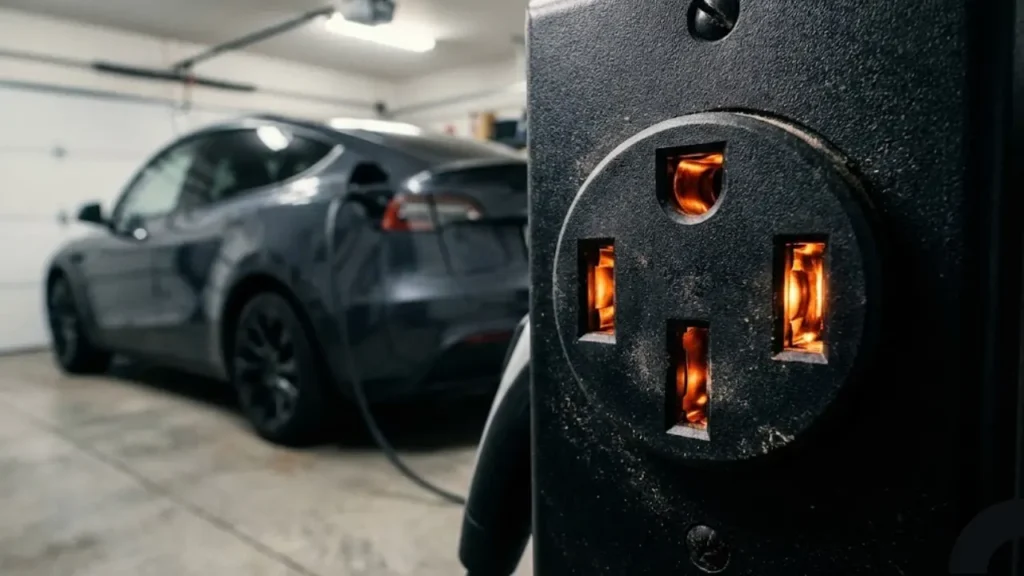
You just bought an electric vehicle. You plug it into the standard outlet in your garage, and the screen says: “Time to full charge: 3 Days.”
Panic sets in. This “trickle charging” won’t work for your daily commute.
You start googling solutions and keep seeing one code repeated everywhere: NEMA 14-50. Is it a special charger? A fancy adapter? No. It is simply a power outlet—but it is the most important upgrade you will make for your EV.
🔌 What is a NEMA 14-50 Outlet?
The NEMA 14-50 is a 240-volt, 50-amp electrical outlet commonly used for electric cooking ranges and RV parks. In the EV world, it is the “Gold Standard” for home charging.
By installing this outlet, you upgrade from “Level 1” (slow) to “Level 2” (fast) charging, allowing you to fully charge a Tesla overnight without buying an expensive wall station.
Speed Test: Why You Need This Upgrade
The difference between a regular household plug and a NEMA 14-50 is like filling a swimming pool with a garden hose versus a fire hose.
| Outlet Type | Voltage | Charging Speed (Miles/Hour) |
|---|---|---|
| Standard Wall Plug (NEMA 5-15) |
120V | 3 – 5 miles/hr 🐌 |
| NEMA 14-50 (The EV Standard) |
240V | 30 – 35 miles/hr 🚀 |
With a NEMA 14-50, you can wake up to a full battery every single morning. Want to see the detailed charging curves? Check out our guide: How Long Does it Take to Charge a Tesla? (Wall vs Supercharger).
👀 How to Identify a NEMA 14-50
Not all big plugs are the same. A NEMA 14-50 has exactly 4 Holes (Prongs):
- Top: Round hole (Ground)
- Bottom: Straight slot (Neutral)
- Sides: Two vertical straight slots (Live Hot Wires)
Note: If your outlet only has 3 holes (angled slots), it is likely an old dryer outlet (NEMA 10-30). Do not force your EV plug into it!
Decision Time: NEMA 14-50 vs. Tesla Wall Connector
This is the most common dilemma for new owners. Tesla sells a dedicated “Wall Connector” for $450. Is it worth buying, or should you just install a NEMA 14-50 outlet for $50 and plug your mobile cord into it?
Let’s look at the “Pro Level” comparison that sales reps won’t tell you.
- Cost: Low ($50 for the outlet).
- Speed: Good (32 Amps). Adds ~30 miles/hour.
- Flexibility: Unbeatable. You can unplug your EV charger and plug in an RV, a welder, or a different brand of EV charger later. It is “Future Proof.”
- Downside: You have to keep your Mobile Connector plugged in, or pack it up every time you leave.
- Cost: High ($450 for the unit + installation).
- Speed: Maximum (48 Amps). Adds ~44 miles/hour.
- Flexibility: Zero. It is bolted to the wall.
- Upside: Looks sleek, weatherproof for outdoor use, and no “plug melting” risk (more on that later).
The Verdict: Unless you drive 200+ miles every single day and need that extra speed, the NEMA 14-50 is the smarter financial move. It saves you money and gives you a versatile outlet for the future.
Real Installation Costs (Don’t Get Scammed)
Installing a NEMA 14-50 outlet isn’t just about buying a $50 plastic socket. The real cost is the Copper Wire.
EV charging requires a continuous heavy load, so you need thick #6 AWG Copper Wire. The further your garage is from your main breaker panel, the more expensive it gets.
| Distance from Panel | Complexity | Est. Total Cost (Parts + Labor) |
|---|---|---|
| 0 – 10 Feet (Panel is in the garage) |
Simple Run | $250 – $500 |
| 10 – 50 Feet (Panel in nearby room) |
Medium Run | $600 – $1,000 |
| 50+ Feet (Panel in basement/other side) |
Complex Run | $1,200 – $2,000+ |
⚠️ Expert Warning: The “GFCI Nuisance Trip”
This is a detail most bloggers miss. The 2020 NEC (National Electrical Code) requires all garage outlets to have a GFCI breaker (for safety).
However, your Tesla Mobile Charger also has a built-in GFCI. Sometimes, these two conflict, causing the breaker to trip randomly (stopping your charge).
The Fix: If you are hardwiring a Wall Connector, you do NOT need a GFCI breaker. This is one major technical advantage of the hardwired unit over the NEMA plug.
Once you pay for this installation, the daily fuel savings begin. The cost to fill up your “tank” at home is shockingly low compared to gas. See the math here: How much money will you save? (Home Charging Analysis).
⚠️ The $10 Mistake That Can Burn Your Garage
This is the most critical part of this guide. If you skip this, you are putting your home at risk.
If you go to a local hardware store (like Home Depot or Lowe’s), you will find a NEMA 14-50 outlet for about $10 to $15 (usually Leviton brand). It looks fine. It fits the plug.
🔥 DO NOT BUY THE CHEAP OUTLET
Here is the Physics: Those cheap outlets are designed for electric dryers. A dryer runs for 45 minutes and stops. It has time to cool down.
An Electric Vehicle pulls maximum power continuously for 6 to 9 hours. This “Continuous Load” generates massive heat. Cheap residential-grade outlets have loose contacts that cannot handle this stress. They overheat, melt the plastic, and can eventually cause a fire.
The Solution: Industrial Grade (Hubbell/Bryant)
To sleep soundly at night, you must buy an “Industrial Grade” receptacle. Yes, they cost significantly more ($50 – $90), but they are built like tanks.
- Price: ~$12
- Material: Plastic & Aluminum
- Weight: Very Light
- Risk: High Melting Risk
- Price: ~$50 – $90
- Material: Heavy Duty Brass
- Weight: Heavy (Cold to touch)
- Risk: Zero (Designed for EVs)
It’s cheaper than a fire.
Even the best outlet will fail if the wires are loose. Ensure your electrician uses a Torque Screwdriver to tighten the screws to the exact manufacturer specification (usually 75 in-lbs). “Hand tight” is not enough for 50 Amps!
Using the right equipment is just step one. There are other safety rules you must follow when dealing with high-voltage charging.
Read our essential safety checklist here:
Extension Cord EV Charging Safety: Don’t Burn Your House Down.
🧩 The “Missing Piece” Problem
Here is a surprise that catches many new owners off guard: Tesla no longer includes the NEMA 14-50 adapter with the car.
Since 2019, the Mobile Connector kit only comes with a standard household plug (NEMA 5-15). If you install a NEMA 14-50 outlet but don’t buy the specific adapter, you will have a fancy outlet with no way to plug your car into it.
Action Item: Go to the Tesla Shop or order the “Gen 2 NEMA 14-50 Adapter” ($45) before your electrician arrives.
Need More Reach? (Heavy Duty Cords)
Sometimes, the outlet is just too far from the car charging port. You absolutely CANNOT use a regular orange extension cord from the garage. It will melt instantly.
You need a specialized “50-Amp RV/EV Extension Cord” (STW 6/3 + 8/1 Wire Gauge). These are thick, heavy, and expensive ($100+), but they carry the current safely.
- Look for “UL Listed” cords.
- Brands like Camco or GearIT are popular among EV owners.
- Keep the length as short as possible (15ft or 30ft max) to prevent voltage drop.
Frequently Asked Questions (FAQs)
Yes, but it must be in a “Weatherproof” enclosure. You need a NEMA 3R rated box that covers the outlet and the plug to protect it from rain and snow.
It provides roughly 30 to 35 miles of range per hour. For a standard Model Y or Model 3, this means a full 0-100% charge takes about 8 to 10 hours (perfect for overnight charging).
Yes. A NEMA 14-50 is a 4-wire configuration (2 Hots, 1 Neutral, 1 Ground). If your existing wiring only has 3 wires, you might need a NEMA 6-50 outlet instead (which has no neutral) or run new wire.
Installing a high-quality NEMA 14-50 outlet is the “Sweet Spot” of EV charging.
It is fast enough to replace gas stations, cheaper than a hardwired wall charger, and versatile enough for future needs. Just remember: Buy the industrial-grade outlet, not the cheap one!
⚠️ Electrical Safety Warning: GreenMount Motors is an informational website, not a professional electrical service. Dealing with 240V electricity is dangerous and can be fatal. All installation work described in this guide should be performed by a licensed, bonded, and insured electrician in accordance with your local building codes (NEC). We accept no liability for property damage or injury.
💰 Affiliate Disclosure: This post contains affiliate links. If you purchase an industrial-grade outlet or extension cord through our links, we may earn a small commission at no extra cost to you. We only recommend products (like Hubbell/Bryant) that meet strict safety standards.