
The biggest fear for any new EV buyer isn’t the price—it’s the waiting game. You are used to a 5-minute gas station stop. The idea of waiting 8 hours to “refuel” sounds painful.
But here is the truth: You are thinking about it wrong.
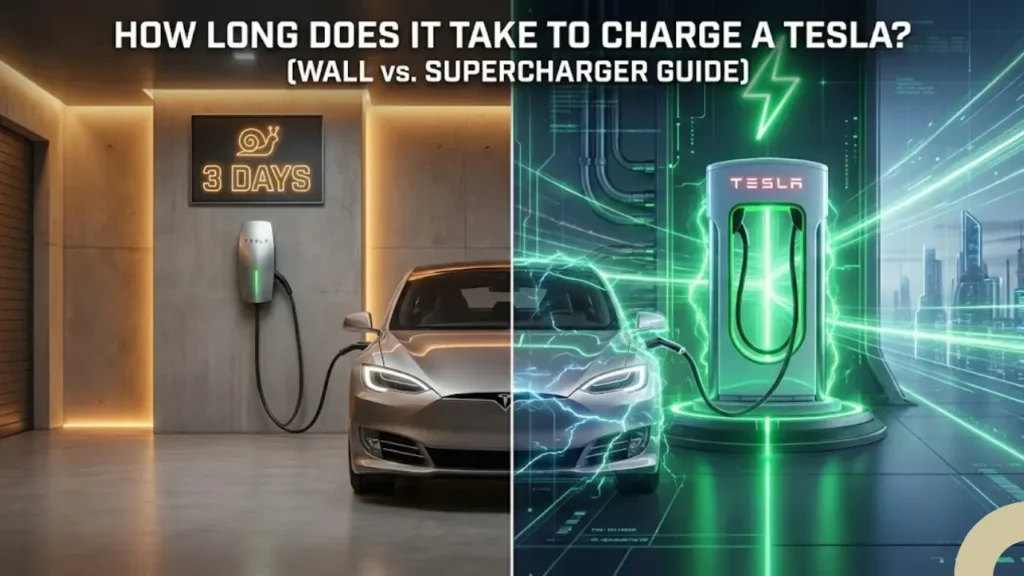
Asking “How long does it take to charge a Tesla?” is like asking “How long does it take to charge a phone?” It depends on whether you are plugging it into a tiny wall cube or a high-speed USB-C brick. The time varies from 15 minutes to 4 days.
⚡ Quick Answer: Tesla Charging Times (2026)
The time to charge a Tesla depends on the power source (Level):
1. Supercharger (Road Trips): 15 to 25 minutes (adds ~200 miles). This is the fastest method.
2. Home Wall Connector (Level 2): 6 to 9 hours (Full charge overnight). This is how 90% of charging happens.
3. Standard Wall Outlet (Level 1): 3 to 4 days. This is extremely slow and only for emergencies.
The Speed Chart: “Miles Per Hour”
Instead of counting hours, think in terms of “Miles Added Per Hour” (MPH). This tells you exactly how far you can drive after 60 minutes of plugging in.
| Charging Method | Voltage / Speed | Time to Full (0-100%) |
|---|---|---|
| 🐌 Level 1 (Regular Home Outlet) |
3 – 5 miles/hour | 3 – 4 Days |
| 🏠 Level 2 (Tesla Wall Connector) |
30 – 44 miles/hour | 6 – 9 Hours |
| 🚀 Level 3 (Tesla Supercharger) |
Up to 1,000 miles/hour | 25 – 35 Mins |
Stop thinking “0% to 100%.” You rarely drive your car until it dies.
Treat your Tesla like your smartphone. You plug it in when you get home (Level 2), and you wake up with a full battery every morning. The “charging time” is effectively zero because you are sleeping while it happens.
However, if you are stuck using the slow Level 1 (Mobile Connector), be careful. Using standard household extension cords to reach your car can be dangerous and slow down charging even more due to voltage drop.
Before you plug into a regular outlet, read our safety guide: Extension Cord EV Charging Safety: Do’s and Don’ts.
2. Home Charging: The “Sleep Test”
Most Tesla owners charge at night. Therefore, the total time to charge 0-100% doesn’t matter as much as “How many miles can I recover while I sleep?”
Let’s run the “10-Hour Sleep Test” on the two types of home setups.
Using a standard 120V plug (like a toaster).
+40 Miles(Barely enough for a short commute)
Using a Dryer outlet or Tesla Wall Connector.
+440 Miles(A full 100% tank every morning)
Level 1: The “Drip Feed” (Avoid This)
Charging a Tesla with a standard wall outlet adds about 3 to 4 miles of range per hour. If you arrive home with a near-empty battery, it could take 4 full days to recharge.
This is only viable if you drive less than 30 miles a day. For everyone else, it is painfully slow.
Level 2: The “Firehose” (Get This)
This is the proper way to own an EV. By installing a 240V outlet (NEMA 14-50) or a dedicated Tesla Wall Connector, you increase charging speed by 10x.
- Speed: 30 to 44 miles added per hour.
- Time to Full: 6 to 9 hours (0% to 100%).
- Convenience: You never wait. The car is always ready when you are.
Actually, no. At home, you pay for the amount of electricity (kWh), not the speed. In fact, Level 2 is often slightly more efficient than Level 1.
See exactly how cheap a full home charge is in our breakdown: Cost to Charge a Tesla: Home vs Supercharger Bills.
3. Supercharging: The “Curve” Trap
This is where new owners get confused. Tesla says you can charge in 15 minutes, but sometimes you sit there for 45 minutes. Why?
Because EV charging is not linear. It follows a “Charging Curve.”
🥛 The “Empty Glass” Rule
Imagine filling an empty glass with water from a high-pressure tap.
- The Beginning (0-80%): You open the tap fully. The glass fills up instantly. (Fast Speed)
- The End (80-100%): You must slow down the water to a trickle so it doesn’t splash over. (Slow Speed)
Pro Tip: On road trips, never charge to 100%. Unplug at 80% and drive. You will arrive at your destination faster by driving than by waiting for that last 20%.
Know Your Supercharger: V2 vs. V3
Not all Superchargers are created equal. If you pull up to an older station, your charging speed might be cut in half.
Found at older stations. If someone parks next to you (Stall 1A and 1B), you share the speed. Your 150kW drops to 75kW. Avoid parking next to others here!
The current standard. No power splitting. You get full speed regardless of who parks next to you. Adds up to 1,000 miles/hour.
⚠️ Why is my charging still slow?
Are you at a V3 Supercharger but only getting 50kW speeds? It might be the weather.
A cold battery cannot accept fast charging. You must “Pre-condition” it. If you don’t know how to do this, you are wasting time.
Read the fix here: Why Is Electric Car Charging Slow? (And How to Speed It Up).
Does Your Model Matter? (LFP vs. Long Range)
Yes. Not all Teslas accept power at the same speed. It depends on the battery chemistry inside your floorboard.
Uses LFP Batteries. Max charging speed is capped at roughly 170 kW. It takes slightly longer to top up, but you can charge it to 100% daily without damage.
🔋 Model 3/Y Long Range & Performance:
Uses NCA/NCM Batteries. Max charging speed hits 250 kW (V3 Supercharger). These are the fastest charging Teslas, but you should limit daily charging to 80%.
*Check your specific vehicle’s charging capabilities on the Official Tesla Supercharging Page.
Frequently Asked Questions (FAQs)
At a Tesla Supercharger (Level 3), it takes 15 to 25 minutes to add 200 miles of range. At non-Tesla “Destination Chargers” (Level 2 found at hotels), it takes several hours, similar to home charging.
Not yet. The fastest you can charge is about 15 minutes for 200 miles. However, since you leave home with a full “tank” every morning, you rarely need to stop at all unless you are on a long road trip.
Frequent Supercharging has a minimal effect on battery health compared to home charging. Tesla’s thermal management system protects the battery very well. However, for daily use, slower home charging is recommended.
The answer is 10 seconds.
That is the time it takes to plug in your car when you get home. The rest happens while you sleep. Stop worrying about “hours” and start enjoying the convenience of waking up full.
Pingback: NEMA 14-50 Outlet Guide: Best EV Charger Setup? (Cost & Safety) - greenmountmotors.com