
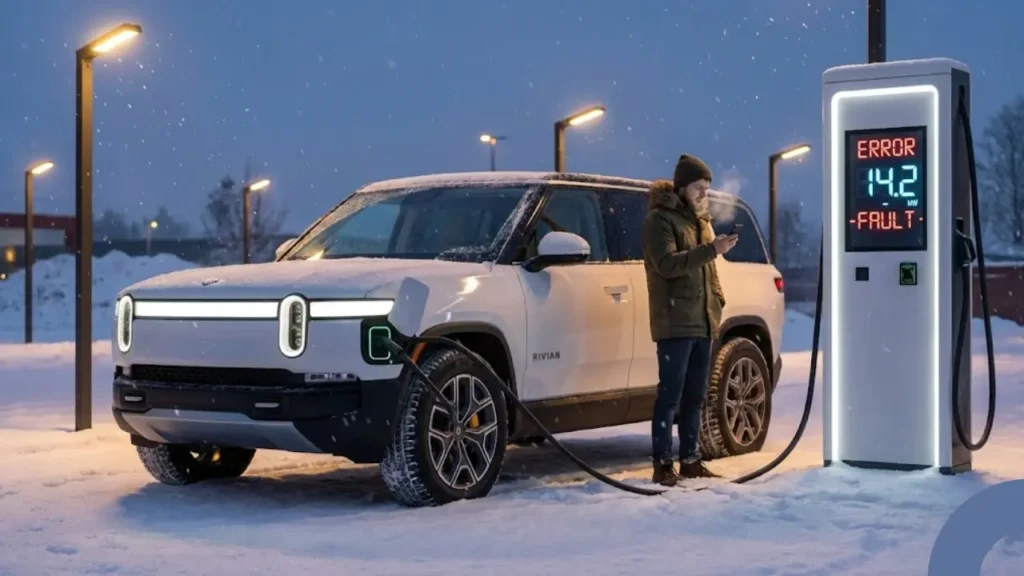
You pull up to a DC Fast Charger, expecting to see those blazing fast kW numbers you were promised at the dealership. You plug in, grab a coffee, and check your app—only to find your EV is charging at a snail’s pace.
It’s frustrating. It adds time to your commute. And worst of all, it makes you wonder: “Is something wrong with my battery?”
Before you panic and call service, you should know that in 90% of cases, your car is behaving exactly as it was designed to. Modern Electric Vehicles (EVs) have complex Battery Management Systems (BMS) that constantly throttle speeds to protect your hardware.
The most common reasons for slow EV charging are:
- Cold Battery: The battery isn’t preconditioned (too cold to accept fast energy).
- High State of Charge (SoC): You are charging past 80%, hitting the “charging curve.”
- Charger Limitations: The station’s output is lower than your car’s max acceptance rate.
- Shared Power: Using a split-stall station where power is shared with a neighbor.
- Cable Issues: A faulty cooling sensor in the charging handle.
Let’s dive deep into each factor so you can diagnose the issue and get back on the road faster.
1. You Hit the “Charging Curve” (The 80% Rule)
This is the #1 reason new EV owners experience slow charging speeds. You might have heard manufacturers claim “10% to 80% in 18 minutes.” Notice they never say “10% to 100%.”
Think of your EV battery like a movie theater. When the theater is empty (low battery), people can run in and find a seat quickly (fast charging). But when the theater is 80% full, people have to walk slowly, look for open spots, and squeeze past others. The flow of people naturally slows down.
Similarly, as your battery gets full, the BMS (Battery Management System) reduces the voltage to prevent the lithium-ion cells from overheating or degrading. This is called the Charging Curve.
Expected Speed Drop-off
Here is a typical example of how drastically speeds drop for a standard EV (like a Tesla Model Y or Hyundai Ioniq 5) at a 150kW station:
| State of Charge (SoC) | Typical Charging Speed | Status |
|---|---|---|
| 0% – 20% | 120kW – 250kW (Max) | 🚀 Super Fast |
| 20% – 60% | 90kW – 150kW | ⚡ Fast / Steady |
| 60% – 80% | 50kW – 90kW | 📉 Slowing Down |
| 80% – 100% | 10kW – 40kW | 🐢 Crawling |
The Takeaway: If you are sitting at a charger with 85% battery wondering why it’s only pulling 30kW, nothing is broken. Your car is intentionally protecting itself. On road trips, it is almost always faster to unplug at 80% and drive to the next station than to wait for that last 20%.
2. The “Coldgate” Effect: Temperature Matters
Batteries are a lot like humans—they are most comfortable at moderate temperatures, typically around 70°F (21°C). When the temperature drops below freezing, the electrochemical reactions inside your lithium-ion battery slow down significantly.
According to data from Recurrent Auto, which analyzes thousands of EVs across the US, charging speeds can drop by up to 30-50% in freezing conditions if the battery isn’t warmed up.
Why does this happen?
When lithium ions are cold, they move sluggishly. If a fast charger tries to force high power (kW) into a cold battery, it can cause “lithium plating,” which permanently damages the cells. To prevent this, your car’s BMS acts as a bouncer, strictly limiting how much power gets in until the battery warms up.
Most modern EVs (Tesla, Kia EV6, Ford Mustang Mach-E) have a feature called “Battery Preconditioning.” If you set the charging station as your destination in the car’s GPS, the car will artificially heat the battery while you drive. This ensures that when you arrive, the battery is warm and ready to accept max speeds immediately.
3. The “Weakest Link” Rule (Equipment Limits)
A common misconception is that plugging into a “350kW Hyper-Fast” charger means you will get 350kW speeds. Unfortunately, charging speed is determined by the weakest link in the chain.
The chain has two main parts:
- The Dispenser (The Pump): How much power the station can give.
- The On-Board Charger/BMS (The Tank): How much power your car can take.
For example, a Chevy Bolt EV is hardware-limited to a maximum fast-charging speed of about 55kW. Even if you plug it into a massive 350kW Electrify America station, it will never draw more than 55kW. It’s like trying to fill a water balloon with a fire hose—the balloon simply can’t handle the pressure.
On the flip side, if you drive a Porsche Taycan (capable of 270kW) but plug into a generic 50kW city charger, you will be limited to 50kW.
For a detailed breakdown of charging levels (Level 1, 2, and DC Fast), you can reference the official guide by the U.S. Department of Energy.
Check Your Voltage (400V vs 800V)
We are currently in a transition period between 400-volt architecture (Tesla, Ford, VW) and 800-volt architecture (Hyundai Ioniq 5, Kia EV6, Porsche, Lucid).
If you plug an 800V car into an older 400V charger, the car has to use an internal DC-DC converter to step up the voltage, which is often slower than the charger’s advertised max speed. Always check your car’s manual to understand its specific voltage requirements.
4. You Are Sharing Power (The “Split” Stall)
This is a detail that catches almost everyone off guard. Many public charging networks (especially Tesla Superchargers V2 and some Electrify America sites) use a load-sharing architecture.
If you pull up to a station and see stalls labeled 1A and 1B, they likely share a single power cabinet.
Here is how the math works: If the cabinet has 150kW of total capacity:
- Scenario A: You park at 1A. No one is at 1B. You get the full 150kW.
- Scenario B: Someone pulls into 1B while you are charging. The station instantly splits the power. Now, you both might only get 75kW each.
Pro Tip: Always try to pick a stall with a unique number (e.g., if someone is at 1A, try to park at 2A or 3A, not 1B). Leaving a space between cars isn’t just polite; it’s faster.
5. Broken Sensors & Cable Issues
High-speed charging cables are heavy because they contain liquid cooling systems to prevent the wire from melting under massive electrical current. Inside the handle, there are temperature sensors.
If a sensor malfunctions—or if the cooling system in the cable is broken—the station will detect a potential safety hazard. Instead of shutting down completely, it will often enter a “Safe Mode,” throttling the speed down to a crawl (usually around 30kW).
If you know your battery is warm and low on charge, but the station is still slow, the hardware is likely to blame.
⚡ Troubleshooting Checklist: What To Do Right Now
Stuck at a slow charger? Run through this 1-minute diagnostic list:
-
✓
Switch Stalls: This solves 50% of issues. If the cable is faulty, moving to the next dispenser usually fixes it.
-
✓
Check PlugShare App: Open the PlugShare app and check recent check-ins for that specific location. Are other drivers reporting slow speeds? If so, the site might be undergoing maintenance.
-
✓
Check Car Settings: Ensure you haven’t accidentally lowered the “Amperage Limit” in your EV’s charging menu or left “Eco Mode” on.
-
✓
Is Your Battery Too Cold? If you didn’t navigate to the charger, your car might still be warming up. Give it 10-15 minutes to see if speeds increase.
Frequently Asked Questions
Does fast charging damage my battery?
Frequent DC fast charging can accelerate battery degradation slightly over time due to heat. However, modern EVs have sophisticated cooling systems to minimize this damage. For daily driving, Level 2 (Home) charging is recommended to prolong battery life.
Why does my charging speed drop after 80%?
This is a safety feature designed by the manufacturer. Charging slows down drastically after 80% to balance the battery cells and prevent overheating. It is often faster to unplug at 80% and drive to the next station than to wait for a full 100% charge.
Is it normal for charging to be slower in winter?
Yes. Lithium-ion batteries are less efficient in cold weather. Charging speeds can drop by 30-50% in freezing temperatures if the battery has not been preconditioned (warmed up) before plugging in.
Final Thoughts
Seeing a low charging speed can be annoying, especially when you are in a rush. But remember, in most cases, your car is not broken. It is simply protecting its most expensive component—the battery.
By preconditioning your battery before you arrive, avoiding shared stalls, and unplugging at 80%, you can slash your waiting time significantly.
🗣️ Join the Discussion: Have you experienced exceptionally slow charging at a specific network like Electrify America or EVgo? Let us know your experience in the comments below!
Pingback: What Do Tesla Charge Port Lights Mean? (Red, Blue, Green Guide) - greenmountmotors.com
Pingback: How Much Range Does an EV Lose in Winter? (Real Data & Tests) - greenmountmotors.com
Pingback: Can You Use an Extension Cord to Charge an EV? (Safety Guide) - greenmountmotors.com
Pingback: How Long Can an Electric Car Sit Without Driving? (Airport Guide) - greenmountmotors.com
Pingback: Why Do EV Tires Wear Out So Fast? (Physics & Solution) - greenmountmotors.com
Pingback: How to Clean Your EV Charging Port Safely (Without Shock Risk) - greenmountmotors.com