
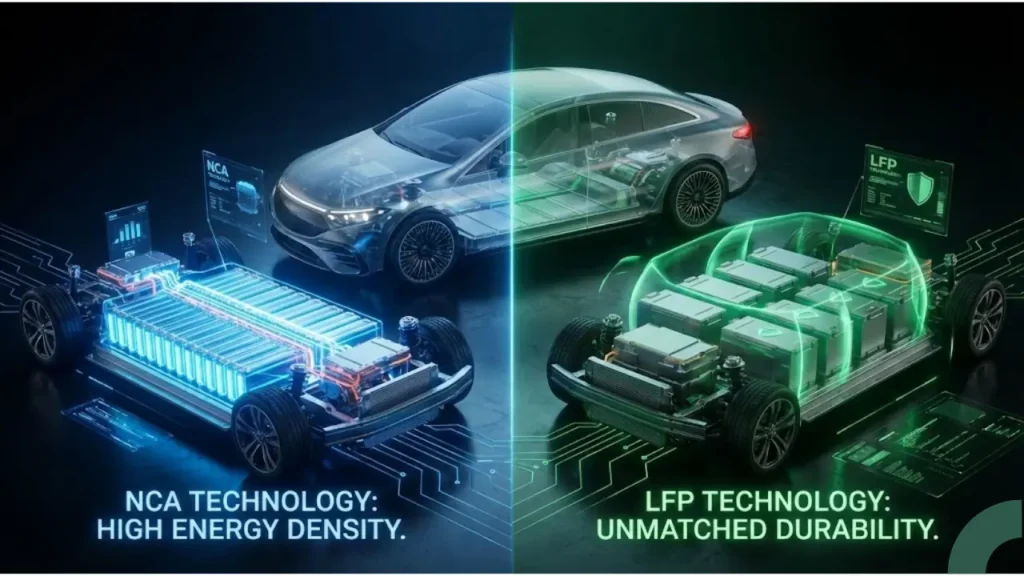
It is the most debated question in the EV community. One friend tells you, “Never charge past 80% or you’ll kill your battery!” Another friend (who drives a new Model 3) says, “My manual says charge to 100% every week!”
So, who is right? The confusing answer is: Both of them.
The “100% Rule” depends entirely on the chemical makeup of the battery sitting underneath your floorboards. Treat an NCA battery like an LFP (and vice versa), and you could be accidentally degrading your range faster than necessary.
⚡ The Short Answer
- If you have an NCA/NCM Battery (Long Range/Performance): Limit daily charging to 80%. Only charge to 100% for long road trips.
- If you have an LFP Battery (Standard Range/RWD): You should charge to 100% at least once a week to keep the BMS calibrated.
The Tale of Two Batteries: LFP vs. NCA
Until recently, almost all EVs in the US used NCA (Nickel Cobalt Aluminum) or NCM batteries. These are high-performance batteries designed for maximum range.
However, newer base-model EVs (especially from Tesla and Ford) are switching to LFP (Lithium Iron Phosphate). These are heavier and hold less energy, but they are incredibly durable.
Here is the critical difference you need to know:
| Feature | NCA / NCM (Performance) | LFP (Standard Range) |
|---|---|---|
| Daily Limit | Stop at 80% | Charge to 100% |
| Why? | High voltage stresses the chemical structure (Rubber Band effect). | Needs to hit 100% to help the car “count” electrons (Calibration). |
| Common Cars | Model Y LR, Mach-E ER, Rivian R1T. | Model 3 RWD, Mach-E Std, Commercial Vans. |
Now, the million-dollar question: How do you know which one you have? You cannot tell just by looking at the car from the outside.
How to Know If You Have LFP or NCA?
You don’t need to call the dealership or pop the hood. The easiest way to tell is by looking at your car’s charging screen or software menu.
🚗 For Tesla Owners
Tesla makes it very easy to check. Follow these steps while sitting in your car:
- Tap the Car Icon (Controls) on the bottom left.
- Tap Software.
- Tap Additional Vehicle Information (blue text).
- Look for “High Voltage Battery”.
What the screen says:
- “Lithium Iron Phosphate” = You have LFP. Charge to 100% weekly!
- “NCA” or nothing specified = You have NCA/NCM. Stop at 80% daily.
The “Charging Slider” Hack
If you don’t want to dig through menus, just look at your charging limit slider on the screen or in the Tesla App.
- NCA/NCM Layout: The slider will have clear markings for “Daily” (50-80%) and “Trip” (80-100%). The car actively discourages you from going into the “Trip” zone unless necessary.
- LFP Layout: The slider will not have “Daily” or “Trip” sections. It simply lets you slide all the way to 100% without giving you any warnings.
For Ford, Rivian, and Hyundai Owners
For other manufacturers, check your Window Sticker (Monroney Label) or the owner’s manual.
- Ford Mustang Mach-E: Most “Standard Range” models produced after 2023 use LFP batteries. “Extended Range” models use NCM.
- Rivian: Currently, most Rivian vehicles use NCA/NCM, meaning the 80% rule strictly applies unless you purchased a specific “Standard Pack” (LFP).
Why NCA/NCM Batteries Hate 100% (The “Rubber Band” Analogy)
If you have a Long Range or Performance model (NCA/NCM), charging to 100% daily is the quickest way to degrade your battery health.
Think of your battery like a rubber band:
- At 50% Charge: The rubber band is relaxed. It is happy sitting there.
- At 100% Charge: The rubber band is stretched to its absolute limit. If you keep it stretched tight like that every single night, eventually, it loses its elasticity.
In scientific terms, keeping lithium-ion cells at high voltage (100%) accelerates “parasitic reactions” inside the electrolyte. According to detailed research by Battery University, a battery kept constantly at 100% can lose capacity twice as fast as one kept at 75-80%.
Why LFP Batteries Need 100% (The “Blind Spot”)
If you have an LFP battery, the rules are completely flipped. Tesla actually recommends charging these to 100% at least once a week. But why?
It’s not about chemistry—it’s about Calibration.
LFP batteries have a very “flat” voltage curve. This means the voltage at 40% looks almost identical to the voltage at 80%. This makes it extremely difficult for your car’s computer (BMS) to guess exactly how much energy is left.
If you never charge to 100%, the car’s guess gets “drifty.” It might say you have 20% left, but the battery is actually empty, leaving you stranded.
By charging to 100%, you force the battery to hit a specific voltage ceiling. This acts like a “Reset Button,” telling the computer, “Okay, THIS is exactly what full looks like.”
Even Tesla’s Official Owner’s Manual states that for LFP vehicles, you should keep the charge limit set to 100% and charge fully regularly to maintain accurate range estimates.
Frequently Asked Questions
Is it okay to charge to 100% occasionally?
Yes. If you have an NCA/NCM battery, charging to 100% for a road trip is perfectly fine. The damage occurs when the car sits at 100% for days. Try to time your charge so you hit 100% right before you start driving.
Does fast charging to 100% damage the battery?
Charging the last 20% (from 80% to 100%) at a Fast Charger takes a long time and generates heat. While not catastrophic, it is inefficient. It is better to unplug at 80% unless you absolutely need the range to reach the next stop.
Will charging to 100% void my warranty?
No. Manufacturers like Tesla and Ford have built-in buffers (top and bottom) that you cannot access. Charging to “100%” on your screen is technically not the physical limit of the cells, so your warranty remains safe regardless of your charging habits.
Final Thoughts
The days of “never charge to 100%” being a universal rule are over. As LFP technology becomes more common in standard-range vehicles, knowing your battery chemistry is just as important as knowing what kind of fuel to put in a gas car.
To summarize:
- NCA/NCM (Long Range): Treat 100% like a special occasion.
- LFP (Standard Range): Treat 100% like a weekly routine.
🚗 Which battery do you have?
Check your car’s screen right now and let us know in the comments if you are on Team LFP or Team NCA!
Pingback: Why Do EV Tires Wear Out So Fast? (Physics & Solution) - greenmountmotors.com
Pingback: Tesla Battery Replacement Cost (2026): The Real Price of a New Pack - greenmountmotors.com