
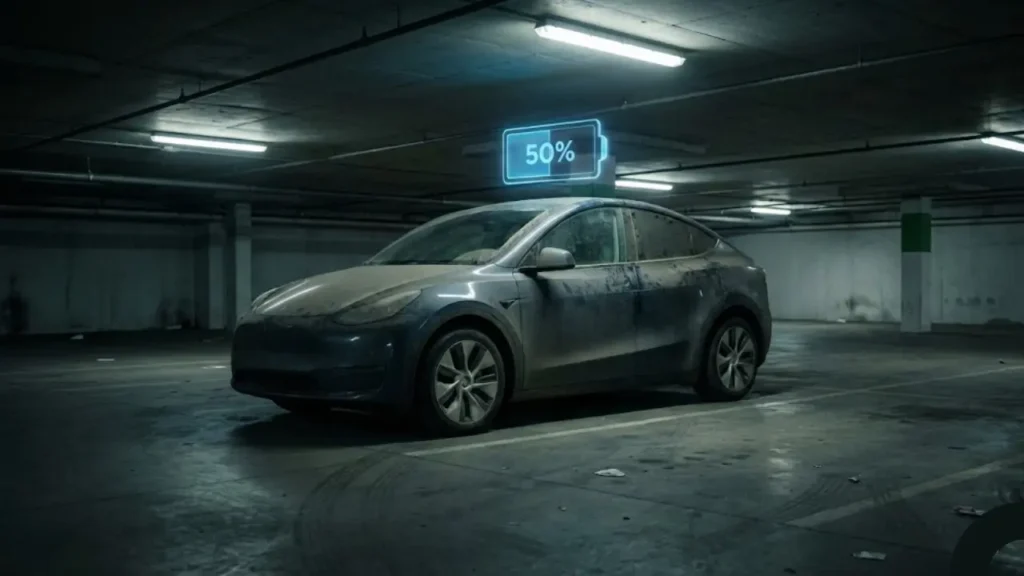
You are packing for a two-week vacation to Hawaii. The bags are in the trunk, the Uber is canceled, and you decide to drive your EV to the airport. But as you lock the car in the long-term parking lot, a thought hits you:
“Will my car still be alive when I get back?”
We have all heard horror stories of EVs turning into “bricks” after sitting idle. But the reality is very different. An electric car can sit for months without dying—if (and only if) you turn off the “Vampire” settings.
✈️ Quick Answer: How Long Will It Last?
If you leave your car parked with 80% battery, here is exactly how long it will survive based on your settings.
| Mode | Daily Loss | Survival Time (approx) |
|---|---|---|
| Sentry Mode ON (Cameras Recording) |
-15% / Day | 5-7 Days (Dead in a week!) |
| Standby / Idle (Always Connected) |
-1% / Day | ~2-3 Months (Safe for vacations) |
| Deep Sleep (Energy Saving Mode) |
~1% / Month | 6-12 Months (Long-term storage) |
But why exactly does the battery drain even when the car is completely off? Welcome to the world of “Vampire Drain.”
Why Does Your Car Lose Range While Parked? (Vampire Drain)
Unlike a gas car, which sits completely dormant when the engine is off, an electric car is more like a sleeping laptop. It is never truly “off.”
The onboard computer is constantly monitoring thermal management, cellular connectivity, and security systems. This background energy usage is called Vampire Drain (or Phantom Drain). While a loss of 1% per week is normal, some owners lose 5% per day. Why? Usually, it is one of these three culprits.
1. The #1 Killer: Sentry Mode & Gear Guard
If you leave your Tesla at the airport with Sentry Mode active, the car keeps its Autopilot computer awake to process video feeds from 8 cameras. It’s equivalent to leaving a powerful gaming PC running 24/7.
The Cost: This consumes roughly 200-300 watts continuously. Over a 10-day trip, this will drain 60-70 kWh of energy—basically an entire battery pack.
2. “Obsessive App Disorder”
We get it. You are anxious about your car, so you open the Tesla/Ford app on the beach to check the percentage. Stop doing that!
Every time you open the app, you send a “Wake Up” signal to the car. The car has to boot up its high-voltage systems to send you data, using significant energy before going back to sleep. Check it once, then close the app.
3. Extreme Temperatures (Hot or Cold)
Batteries are like humans; they hate being too hot or too cold. If you park in scorching heat (Cabin Overheat Protection active) or freezing cold, the car will use its own energy to heat or cool the battery pack to keep it safe.
In winter, you might see a sudden drop in percentage not because the energy is “lost,” but because the cold battery cannot access it (locked ions). This same chemistry is why charging speeds tank in winter.
Read more about how temperature affects your battery speed: Why Is My Electric Car Charging So Slow?
The “Departure Checklist” (Do This Before You Fly)
Don’t overthink it. Just follow this 4-step checklist 10 minutes before your Uber arrives, and your car will be perfectly fine when you return.
This is non-negotiable. According to Tesla’s Owner Manual, Sentry Mode prevents the car from sleeping and can drain 30-40 miles of range per day.
If you are leaving it plugged in, lower the limit to 50% (or 60%). Do not keep it sitting at 100%.
Tires naturally lose about 1 PSI for every 10°F drop in temperature, states Firestone Auto Care. Add 2-3 extra PSI before you leave to prevent flat spots.
Remove dash cams, OBD scanners, or USB drives. Sometimes these prevent the car from entering “Deep Sleep.”
The Big Question: Should I Leave It Plugged In?
Yes, if possible. Manufacturers recommend “A.B.C.” (Always Be Charging). If you leave it plugged in, the car draws power from the wall for its systems instead of the battery.
Check our Safety Guide: Can You Use an Extension Cord Safely?
Traveler FAQs
Should I ask a friend to drive it once a week?
No. Short drives actually hurt more than help. They wake up the car, heat up the battery, and don’t last long enough to charge the 12V battery fully. It is better to let the car sleep undisturbed.
What happens if the battery hits 0%?
If it hits 0%, the car shuts down. If it sits at 0% for weeks, the low voltage can chemically damage the battery pack (“bricking” it), requiring a replacement that costs $15,000+. Avoid 0% at all costs.
Final Thoughts
Leaving your EV for a month is not dangerous—neglecting the settings is. If you simply turn off Sentry Mode and stop checking the app every hour, your electric car is arguably better at sitting idle than a gas car (no battery rot, no fuel gumming).
Enjoy your trip, trust the “Deep Sleep” mode, and come back to a car that’s ready to drive home.
Pingback: Tesla Screen Black? How to Restart in 10 Seconds (Safe While Driving) - greenmountmotors.com