
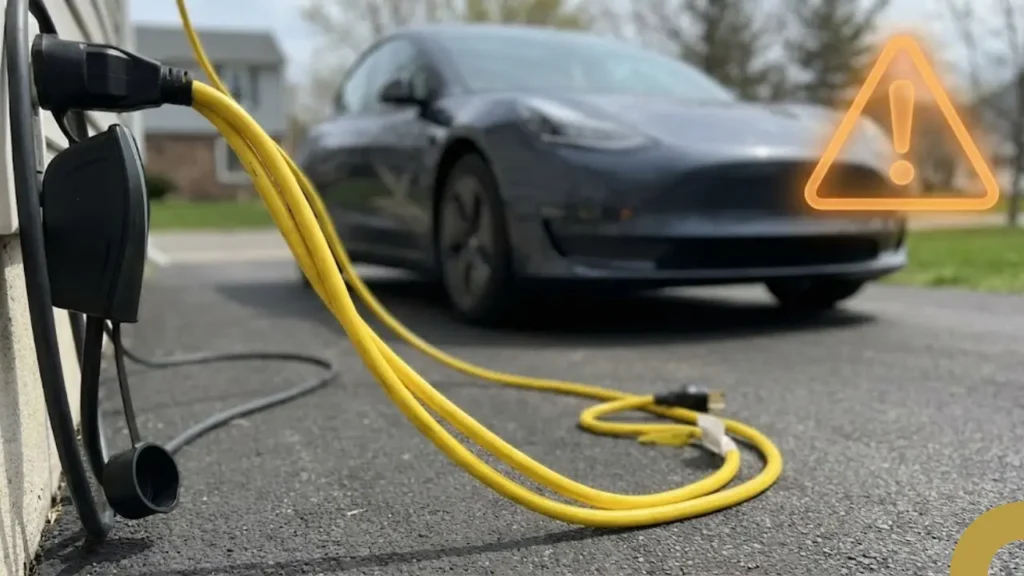
You are visiting family for the holidays. You pull into the driveway, open your trunk, and realize your mobile charger cable is 5 feet too short to reach the outlet. You spot an old orange extension cord in the garage. Can you use it?
The manual says “Absolutely Not.” The internet says “Maybe.”
Here is the truth: Using the wrong extension cord is a leading cause of electrical fires. However, if you follow strict guidelines from the National Fire Protection Association (NFPA) and use the correct heavy-duty equipment, it can be done safely in an emergency.
⚠️ STOP! Read This Before Plugging In
NEVER use a standard household extension cord (the thin ones used for lamps). They cannot handle the continuous load of an EV and will melt or catch fire within hours. Even Tesla’s Owner Manual explicitly warns against using any extension cords due to this risk.
🔌 The 30-Second Verdict: Can I Do It?
| Cord Type | Verdict | Why? |
|---|---|---|
| Household Cord (16-Gauge or 14-Gauge) |
Dangerous | Too thin. Will overheat and trigger sensors. Fire hazard. |
| Heavy Duty Cord (10-Gauge / 10AWG) |
Acceptable | Thick copper wire can handle the continuous 12 Amp load. |
| J1772 Extension (Specialized EV Cable) |
Best / Safest | Designed specifically for EVs. Waterproof and maintains safety protocols. |
Most car manufacturers advise against this to protect themselves from liability. But physics tells us that if the wire is thick enough (Low Gauge), electricity flows safely.
Let’s dive into the science of why thin cords melt and exactly what “Gauge” you need to look for at the hardware store.
Why Do Standard Cords Melt? (The Science)
To understand the danger, you have to realize that charging an electric car is the most demanding task you can ask of a household outlet. It is not like running a vacuum cleaner for 20 minutes; it is like running a hair dryer on maximum heat for 10 hours straight.
1. The “Continuous Load” Rule
Household extension cords are rated for “Peak Load.” They can handle high power for short bursts (like sawing wood). But EVs pull a Continuous Load.
According to electrical codes, any device running for more than 3 hours is a continuous load. Standard 16-gauge or 14-gauge cords are thin. As electrons force their way through that thin copper wire for hours, friction builds up. This friction creates heat, which eventually melts the plastic insulation, leading to a short circuit or fire.
2. The “Voltage Drop” Problem
Have you ever noticed that if you connect two garden hoses together, the water pressure at the end is weaker? Electricity works the same way.
The longer the cord, the more voltage is lost along the way. Your car expects 120 Volts, but by the time it travels through 50 feet of cheap wire, it might only get 105 Volts.
If the voltage drops too low, your car’s computer detects it as “Grid Instability” and drastically lowers the amperage to protect itself. This is why extension cords often result in painfully slow charging. Read more here: Why Is My Electric Car Charging So Slow?
⚠️ The “Sensor Blind Spot” Danger
This is the most critical safety flaw that no one talks about.
Your Tesla or Ford Mobile Connector has a Temperature Sensor built into the plug. If the wall outlet gets too hot, the charger shuts off to prevent a fire.
The Problem: When you use an extension cord, the charger’s sensor is plugged into the end of the cord, not the wall. If the connection at the wall (50 feet away) starts melting or sparking, your charger doesn’t know. It thinks everything is fine and keeps pulling power until the wall outlet catches fire.
Which Cord Should You Buy? (The Safety Checklist)
So, you have decided to take the risk. If you are going to do this, you must buy the right equipment. You have two main options, and one is significantly safer than the other.
Option A: The J1772 Extension Cable (Best Choice)
This is not a standard extension cord. It is a specialized cable that plugs into your car’s charging handle, extending the reach after the charging box.
- Why it is Safer: It extends the cable between the charger and the car. This means your Mobile Connector stays plugged directly into the wall, so its Temperature Sensor remains active and can detect overheating.
- Waterproof: These cables are designed for rain and snow (IP66 rated), unlike standard orange cords.
- Cost: Expensive ($150 – $200), but cheaper than a fire.
Option B: The “Heavy Duty” Household Cord
If you cannot buy a J1772 cable and must go to Home Depot or Walmart, you need to look for exactly ONE number on the packaging: The Gauge (AWG).
Do not use. Too thin.
Acceptable for standard outlets only.
Thickest wire. Required for 20+ Amps.
Rule of Thumb: The lower the number, the thicker the wire. Never buy anything higher than 12 Gauge. If you are charging at 240V (Level 2), you absolutely need a 10 Gauge cord.
The “Life-Saving” Checklist: Do’s and Don’ts
Even if you bought the expensive 10-Gauge cord, you can still melt your outlet if you use it incorrectly. Follow these 4 golden rules every single time you plug in.
🚫 Rule #1: NEVER Leave the Cord Coiled
This is the most common mistake. If your extension cord is 50 feet long but you only need 20 feet, do not leave the rest tightly wound up.
Why? A coiled wire creates an “Induction Coil.” As electricity flows through it, the magnetic fields amplify the heat. A coiled extension cord can melt and catch fire even if it is rated for the load. Always unroll it completely.
✅ Rule #2: The 30-Minute “Touch Test”
Don’t just plug it in and go to sleep. Come back after 30 minutes of charging. Place your hand on the wall outlet and the connection points. They should be warm, but not hot. If they are too hot to touch comfortably, stop immediately.
✅ Rule #3: Elevate the Connection
Never let the connection point (where your car charger plugs into the extension cord) sit on the ground, especially in rain or snow. Wrap the connection tightly in a plastic bag or elevate it on a brick to prevent water from shorting the circuit.
⚠️ Rule #4: Watch for the Red Light
If your car starts charging but stops after a few minutes with a Red Light or an “Interrupted” error, it likely detected a dangerous voltage drop caused by the extension cord.
Don’t ignore this warning. The car is trying to save you from a fire.
👉 Decode the signal: Not sure if the red light means “Power Failure” or just a loose plug? Check our guide: Tesla Charge Port Light Meanings: Red, Blue, or Green?
Frequently Asked Questions
Will using an extension cord void my warranty?
Technically, yes. Most EV manuals (Tesla, Nissan, Ford) explicitly state not to use extension cords. If a fire occurs and investigators find a melted cord, your warranty or insurance claim could be denied.
Can I daisy-chain two cords together?
ABSOLUTELY NOT. Connecting two extension cords increases resistance significantly and adds another point of failure. Always use a single cord of the correct length.
What is the maximum safe length?
Try to stay under 50 feet (15 meters). Beyond 50 feet, voltage drop becomes a serious issue even with thick 10-gauge wire, causing charging speeds to plummet.
Final Verdict
So, can you use an extension cord to charge an EV? Yes, physics allows it, but safety demands respect.
If you are in an emergency, use a 10-Gauge Heavy Duty Cord or, ideally, a J1772 Extension Cable. Never grab the cheap orange cord you use for your leaf blower. Spending $50 extra on the right cable is cheaper than repairing a melted charging port—or your house.
Pingback: How Much Does it Cost to Charge a Tesla? (2026 Real Bills) - greenmountmotors.com
Pingback: How Long Does It Take to Charge a Tesla? (Wall vs. Supercharger Guide) - greenmountmotors.com