
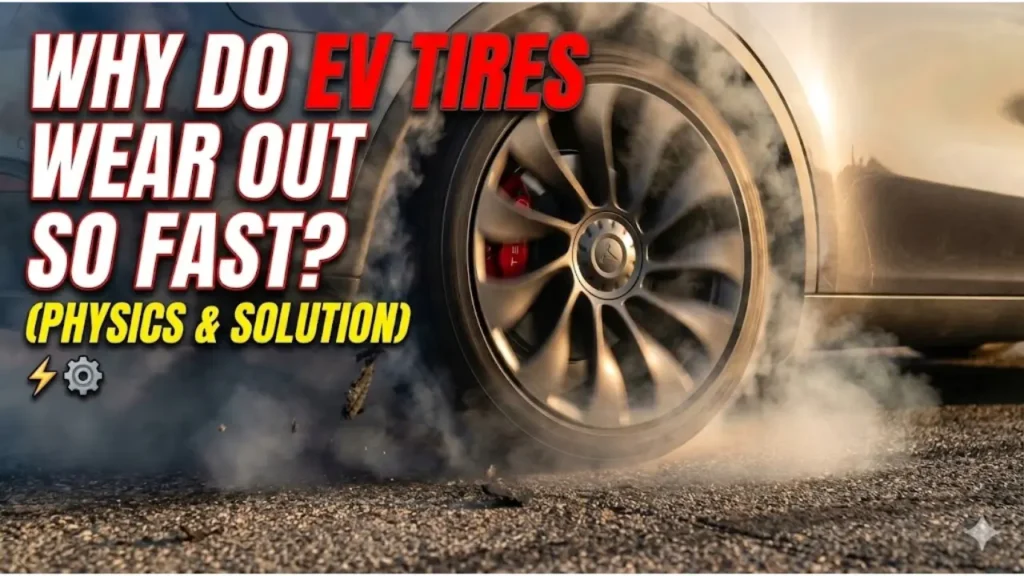
It is a story every new EV owner knows too well. You buy a shiny new Tesla Model Y or Mustang Mach-E. You love the speed, the tech, and the savings on gas.
Then, you take it in for the 20,000-mile service, and the mechanic drops a bomb: “You need four new tires.”
You are shocked. On your old Honda Civic, tires lasted 50,000 miles easily. Did the dealer sell you a lemon? Is the alignment off?
No. Your car is fine. But the laws of physics are working against your rubber. Electric vehicles devour tires 20% to 50% faster than gas cars, and understanding why is the only way to stop bleeding money.
🚗 Quick Answer: Why Do EV Tires Wear Out Fast?
Electric cars wear out tires faster due to three main factors: Weight, Torque, and Regen. EVs are 30% heavier than gas cars due to the battery pack, which increases friction. Additionally, the “Instant Torque” acts like sandpaper on the road during acceleration, and aggressive regenerative braking adds stress during deceleration.
Reason #1: The “Heavyweight” Problem
Let’s talk about the elephant in the room—or rather, under the floorboard. Electric cars are heavy. Incredible heavy.
The lithium-ion battery pack alone can weigh between 1,000 to 2,000 pounds. When you add this to the chassis, an electric SUV can weigh as much as a heavy-duty gas pickup truck.
| Vehicle Type | Model | Curb Weight (lbs) |
|---|---|---|
| Electric Sedan | Tesla Model 3 Long Range | ~4,065 lbs |
| Gas Sedan | Toyota Camry | ~3,310 lbs |
| Difference | +755 lbs (Heavy!) |
Physics 101: Heavier objects push down harder on the road. This increases the Load Index requirement and creates more friction every time the wheel turns. It’s like dragging a heavy eraser across paper versus a light one—the heavy one wears down faster.
Not all EV batteries weigh the same. Standard Range models often use LFP (Lithium Iron Phosphate) batteries, which are actually heavier than Long Range NCA batteries, putting even more stress on your tires.
Check here to see which heavy battery type your car has (LFP vs NCA).
Reason #2: The “Instant Torque” Addiction
This is the fun part, but it costs you money.
In a gas car, when you stomp on the pedal, the engine has to rev up, gears have to shift, and power builds slowly. In an EV, you get 100% torque instantly (in milliseconds).
Every time the traffic light turns green and you zoom ahead of the car next to you, the electric motor sends a massive shockwave of power to the wheels. This causes “micro-slippage.” You might not hear the tires screeching, but the rubber is essentially being grated against the asphalt.
Reason #3: The “Invisible” Brake (Regenerative Braking)
You love “One-Pedal Driving” because it saves your brake pads. But physics dictates that the energy has to go somewhere.
When you lift your foot off the accelerator, the electric motor instantly reverses its polarity to turn into a generator. It grabs the wheels to slow the car down and capture energy. This creates a Reverse Torque force on the tires.
The Result: Your tires are constantly under stress—either being pushed forward by acceleration or pulled back by regen. They never get a break to just “coast” freely like tires on a gas car do.
Do You Really Need “EV Specific” Tires? (The Truth)
When you shop for replacements, you will see tires labeled “EV Tuned” or “T0 (Tesla Approved)” that cost $50-$100 more per tire. Is this just marketing hype, or do you actually need them?
The short answer: Yes, you generally do. Here is the technical breakdown of why standard tires fail on EVs.
| Feature | Standard Tire | EV Specific Tire |
|---|---|---|
| Internal Noise | Loud (Hollow sound) | Silent (Contains acoustic foam) |
| Sidewall Stiffness | Standard | Reinforced (To handle battery weight) |
| Rolling Resistance | High (Grippy but drags) | Low (Glides to save range) |
1. The “Sound of Silence”
Electric cars don’t have an engine to drown out road noise. If you put standard tires on a Tesla Model Y, the “hum” of the rubber on the highway will sound like a jet engine inside the cabin. EV tires (like the Michelin Pilot Sport EV) have a layer of Acoustic Foam glued inside to absorb this noise.
2. Rolling Resistance & Range
This is where you lose money if you buy cheap tires. Standard tires are “sticky.” They create drag.
If you switch to non-EV tires, you might see your range drop by 10-15%. This means you are charging more often and spending more money on electricity.
Sometimes owners think their battery is dying or charging is getting slower, when in reality, they just installed “high-resistance” tires that drain power faster.
Read Guide: Why is my EV charging inefficiently? (Is it the Battery or the Car?)
According to data from Tire Rack’s testing, Low Rolling Resistance (LRR) tires are essential for maintaining the EPA-rated range of your electric vehicle.
The Real Cost: Gas vs. EV Tires (5-Year Analysis)
Let’s talk numbers. Because electric vehicles go through rubber faster and require more specialized (expensive) tires, your maintenance budget needs to adjust.
Here is a realistic comparison of tire costs over 5 years of ownership (driving 15,000 miles/year).
| Vehicle | Avg Tire Life | Cost Per Set | 5-Year Total |
|---|---|---|---|
| Honda CR-V (Gas) | 50,000 miles | $800 | ~$1,200 (1.5 sets) |
| Tesla Model Y (EV) | 25,000 miles | $1,200 | ~$3,600 (3 sets!) |
The Verdict: You will likely spend 3x more on tires with an EV compared to a similar gas car. The fuel savings are real, but some of that money goes back into rubber.
The “Winter Effect” on EV Tires
If you live in a cold climate, your tires are under even more stress. As the temperature drops, air contracts, and your tire pressure (PSI) decreases significantly.
Driving on under-inflated tires increases the “contact patch” with the road. While this gives you better grip, it creates massive friction, heating up the rubber and wearing it down rapidly.
It’s not just about wear. Soft tires in winter create “drag,” which is one of the main reasons your battery drains faster in January than in July.
See the Data: How much range do you actually lose in freezing weather?
The “Flat Spot” Risk
Remember how we said EVs are heavy? That weight causes another unique problem. If you leave your car parked for too long (like during a 2-week vacation), the heavy battery presses the tires into the pavement, creating semi-permanent “Flat Spots.”
When you finally drive off, you’ll feel a terrible vibration in the steering wheel.
Heading to the airport? You need to inflate your tires to the maximum PSI before you leave to prevent this damage.
👉 Read our Long-Term Parking Guide: How to prevent flat spots and battery drain.
How to Make Your EV Tires Last Longer (3 Rules)
You can’t change the weight of your battery, but you can change how you drive. Follow these three rules to extend your tire life from 20,000 miles to 35,000+ miles.
1. Use “Chill Mode”
We know the instant torque is addictive, but it shreds rubber. Most EVs have a setting (Chill Mode in Tesla, Whisper in Ford) that softens the acceleration curve. Using this daily can save you $1,000 every two years in tire replacements.
2. Rotate Every 6,000 Miles
On a gas car, you rotate tires every 10,000 miles. On an EV, you must do it every 6,000 miles. Because electric motors apply torque differently to the front and rear axles, uneven wear happens much faster.
3. Watch Your Dashboard Alerts
Modern EVs are smart. If your alignment is off or your tire pressure drops, the car will tell you. Never ignore a yellow warning light on your dashboard.
Is that yellow icon a flat tire or a charging fault? Understanding your car’s language is the first step to preventing damage.
Guide: What do the different colors and lights mean on your EV?
Common Questions About EV Tires
Does the car warranty cover tire wear?
Generally, no. Tires are considered “wear and tear” items. However, many tire manufacturers (like Michelin) offer a mileage warranty (e.g., 40,000 miles). If they wear out at 20,000, you can often claim a pro-rated discount on your next set.
Can I put regular tires on an EV to save money?
You can, but it’s not recommended. Regular tires may not handle the heavy load index of an EV, leading to blowout risks. They will also reduce your driving range by 10-15% and increase cabin noise significantly.
Final Thoughts
Wearing out tires quickly is the “hidden tax” of owning an electric vehicle. While it is frustrating, the math still works in your favor when you factor in the savings on gas and oil changes.
The secret isn’t finding a magical indestructible tire—it’s changing your habits. Ease up on the pedal, check your PSI monthly, and rotate them religiously. Your wallet will thank you.
Pingback: Best Tires for Tesla Model Y & 3 (Quiet & Efficient Choice) - greenmountmotors.com
Pingback: EV Tire Rotation Guide: How Often & Correct Patterns (Tesla) - greenmountmotors.com