
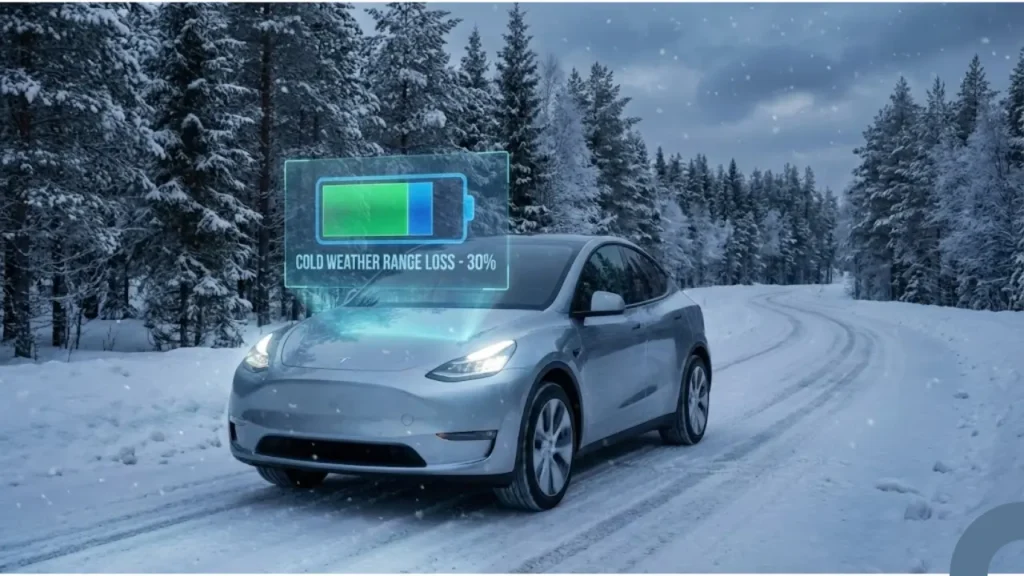
You bought an EV rated for 300 miles. But when the thermometer drops below freezing, does that number still hold up? Absolutely not.
Winter is the ultimate enemy of lithium-ion batteries. But here is the secret most dealers won’t tell you: It is not just the cold air that kills your range—it is how much you use the Cabin Heater.
Based on real-world tests from thousands of EVs, here is exactly how much range you will lose when the temperature drops.
📉 The Cold Truth: Range Loss by Temperature
| Temperature | Loss (Heater OFF) | Loss (Heater ON) |
|---|---|---|
| 70°F (21°C) | 0% (Ideal) | 0% |
| 32°F (0°C) | ~12% Loss | ~31% Loss |
| 0°F (-18°C) | ~20% Loss | ~41% Loss |
Data Source: Aggregated from AAA studies and Recurrent Auto winter reports.
So, why exactly does cold weather make your battery act so sluggish? The answer lies in the chemistry happening under your feet.
Why Does Cold Weather Kill EV Range? (The Science)
To understand why your range drops, you have to think of your battery not as a fuel tank, but as a chemical factory. And like most chemical reactions, this one hates the cold.
A lithium-ion battery works by moving ions between two sides (cathode and anode) through a liquid called an electrolyte. In warm weather, this liquid is runny like water, and ions zip back and forth effortlessly.
🧪 The “Cold Syrup” Effect
Imagine trying to swim through a pool of cold maple syrup. That is exactly what happens inside your battery cells in winter.
The electrolyte thickens, creating Internal Resistance. The battery has to work twice as hard just to push the energy out to the motor. This wasted effort creates heat, but it drains your “miles” faster than usual.
This “thick syrup” effect doesn’t just hurt your driving range; it is also the primary reason why charging takes forever in January.
If your battery is cold, the car intentionally slows down charging to prevent permanent damage to the anode. Learn more about how temperature throttles your speed in our guide: Why Is My Electric Car Charging So Slow?
The Hidden Villain: Lost Regenerative Braking
Many drivers notice the range drop but forget about the “Free Energy” they are losing. In summer, every time you lift your foot off the pedal, the motor turns into a generator and puts energy back into the battery (Regenerative Braking).
In Winter, this stops working.
- The Problem: A cold battery cannot accept a fast charge. To protect itself, the car’s computer (BMS) disables or limits regenerative braking.
- The Consequence: Instead of recapturing energy at a stoplight, you are using physical friction brakes. That energy is lost as heat forever, reducing your overall efficiency by another 10-15%.
👀 Spot the Sign: In a Tesla, you will see a snowflake icon ❄️ or “dots” on the energy bar, indicating that full power and regen are unavailable until the battery warms up.
The Secret Weapon: Heat Pump vs. Resistance Heater
Not all EVs are created equal in the snow. If you see two different electric cars, one might lose 40% of its range while the other loses only 15%. The difference? A piece of technology called the Heat Pump.
🔴 Old Tech: Resistance Heater
Found in older Model 3s and budget EVs.
How it works: It works exactly like a giant toaster or hair dryer. It passes electricity through a wire to create heat.
Energy Cost: High (Consumes up to 4,000 Watts).
🟢 New Tech: Heat Pump
Found in Model Y, new Model 3, and Ioniq 5.
How it works: It works like an A/C in reverse. It doesn’t create heat; it scavenges heat from the outside air and battery motor and moves it into the cabin.
Energy Cost: Low (Consumes only ~500-1,000 Watts).
The Real-World Difference:
In a test conducted at 30°F, a Tesla Model Y (with Heat Pump) maintained nearly 85% of its EPA range, while similar cars with resistance heaters dropped to 65%. That is a difference of roughly 50-60 miles of driving distance.
If you drive a Tesla Model Y, you definitely have a heat pump. If you drive a Model 3 built before 2021, you likely have the older resistance heater. This explains why older EV owners complain more about winter range than new buyers.
5 Proven Ways to Beat the “Winter Range Anxiety”
You cannot change the weather, but you can change how your car reacts to it. By adjusting your habits slightly, you can reclaim up to 15-20% of the range you would otherwise lose. Here are the professional strategies used by veteran EV drivers in places like Norway and Canada.
1. Master the Art of “Departure Scheduling”
This is the single most effective trick in the book. Most modern EVs (Tesla, Ford, Hyundai) allow you to set a “Departure Time” in their app.
Why it works: If you start driving with a cold battery, the car wastes massive amounts of energy from the battery pack just to warm itself up. However, if you schedule your departure while the car is still plugged into your wall charger, it uses Grid Power (electricity from your house) to warm the battery and cabin.
Result: You leave your driveway with a 100% warm battery and a full charge, saving that precious stored energy for actual driving.
2. Heat the Passenger, Not the Air
It sounds counterintuitive, but heating the air inside the cabin is incredibly inefficient. Air is a poor conductor of heat, and the moment you open the door, that warm air escapes.
Instead, rely on Seat Heaters and Steering Wheel Heaters.
- The Math: A typical cabin heater consumes 2,000 to 4,000 Watts. A seat heater consumes only 40 to 60 Watts.
- Strategy: Set the cabin temperature lower (around 66°F or 19°C) and blast the seat warmers. You will feel just as cozy, but your car will consume 90% less energy for heating.
3. Don’t Ignore the “Cold Air Drop”
Physics dictates that for every 10°F drop in temperature, your tire pressure drops by 1-2 PSI. Cold air contracts, leaving you with soft, under-inflated tires.
The Impact: Soft tires create more “Rolling Resistance.” It’s like trying to ride a bicycle with flat tires through sand. The motor has to work harder to push the car, draining the battery. Check your PSI monthly and keep them inflated to the manufacturer’s recommended winter spec.
4. Use “Chill” or “Eco” Mode
Winter roads are often slippery or wet. High torque (fast acceleration) causes micro-slippage of the tires. Even if you don’t feel the slip, the Traction Control system detects it and cuts power momentarily, which is inefficient.
Using Eco/Chill mode dampens the throttle response. This not only makes driving safer on ice but also prevents the car from discharging energy too aggressively, keeping the battery chemistry stable.
5. The “Winter Buffer” Rule
In summer, we often say “don’t charge to 100%” to save battery health. In winter, survival takes priority. A cold battery can sometimes miscalculate how much energy it has left (Voltage Sag). A screen showing 10% might suddenly drop to 0% in freezing conditions.
Should you charge to 100%?
It depends heavily on your battery type. If you have an LFP battery, you absolutely should. If you have an NCA battery, the rules are different.
👉 Essential Read: Before you plug in tonight, check our guide on LFP vs. NCA: Which Battery Do You Have and Should You Charge to 100%?
Common Winter Questions
Should I leave my EV plugged in when not in use?
Yes. Always leave it plugged in during winter (“ABC – Always Be Charging”). This allows the Battery Management System (BMS) to draw power from the wall to keep the battery cells warm, preventing “cold soaking.”
Does parking in a garage help?
Yes, significantly. Even an unheated garage is usually 10-15 degrees warmer than the outside wind chill. This small difference preserves battery heat and reduces the energy needed to warm the car in the morning.
Will my EV start in -20°F weather?
Unlike gas cars, which struggle to crank over frozen oil, EVs start instantly in extreme cold. The motor doesn’t care about the temperature. The only limitation is reduced range.
Final Thoughts
Driving an EV in winter requires a mindset shift. You aren’t losing range because the car is “broken”; you are spending that range to keep yourself comfortable and safe.
By using Preconditioning, trusting your Seat Heaters, and understanding your Battery Limits, you can conquer the cold without range anxiety. Just remember: when the temperature drops, plan for a 20-30% buffer, and you will never be left stranded.
Pingback: Can You Put Regular Tires on an EV? (Risks & Real Cost) - greenmountmotors.com
Pingback: Tesla Charging Adapters Explained: J1772, CCS & NACS Guide (2026) - greenmountmotors.com