
It is the elephant in the room. The one question every skeptic asks you when you buy an electric car: “Yeah, but what happens when the battery dies? Isn’t it like $20,000 to fix?”
Unlike a gas engine which can be repaired part-by-part, the high-voltage battery is often seen as a mysterious, expensive black box. Internet rumors claim prices as high as $30,000, while others say it’s free under warranty.
So, what is the real price in 2026? Let’s look at the actual invoices.
🔋 Quick Answer: How Much Does a New Tesla Battery Cost?
As of 2026, a complete Tesla battery replacement typically costs between $13,000 and $20,000 (including parts and labor).
For the popular Model 3 and Model Y, expect to pay around $13,000 to $16,000. For the larger Model S and Model X, costs can reach $20,000+. However, most replacements are covered for free under Tesla’s 8-year warranty.
Estimated Cost by Model (2026 Data)
The price varies depending on the size of the battery pack (kWh) and whether you choose a brand-new pack or a “Remanufactured” (refurbished) one from Tesla.
| Tesla Model | Battery Size | Est. Replacement Cost |
|---|---|---|
| Model 3 (RWD/Standard) | 50-60 kWh (LFP) | $11,000 – $13,500 |
| Model 3 / Y (Long Range) | 75-82 kWh | $13,500 – $16,000 |
| Model S / X (Legacy) | 85-100 kWh | $15,000 – $22,000 |
| Labor Cost (Avg) | Installation | $500 – $2,500 (included above) |
💡 Perspective: The “Gas Savings” Offset
Seeing a $15,000 bill is scary. But remember, an EV engine has almost zero maintenance (no oil changes, timing belts, or transmission fluid).
Plus, you save massive amounts on fuel daily. Before you panic about a battery you might buy in 10 years, check exactly how much you are saving right now in our guide: How Much Does it Cost to Charge a Tesla? (Real Bill Analysis).
The Bill Breakdown: Parts vs. Labor
Why is it so expensive? Unlike a regular car battery (which costs $150), the high-voltage pack is the structural “floor” of your car. It weighs nearly 1,000 lbs.
Interestingly, the labor isn’t the expensive part. Tesla Service Centers are incredibly efficient at swapping packs.
- The Battery Pack (Parts): Accounts for 90% of the bill ($12k – $14k).
- The Labor: Accounts for only 10% ($500 – $1,500). A skilled technician can swap a Model 3 battery in less than 4 hours.
- Miscellaneous: Coolant refill, high-voltage fuse replacement, and recycling fees ($200 – $500).
Good News: You Probably Won’t Pay a Dime
Before you start saving $15,000 in a piggy bank, look at the warranty. Tesla covers the battery and drive unit for 8 years. This is far longer than the warranty on the rest of the car.
If your battery fails or degrades significantly within this period, Tesla replaces it for free. No deductible, no labor cost.
The coverage depends on which model you own. The clock starts from the day the car was first delivered.
-
Model 3 RWD / Standard Range:
8 years or 100,000 miles (whichever comes first). -
Model Y, Model 3 Long Range & Performance:
8 years or 120,000 miles. -
Model S & Model X:
8 years or 150,000 miles.
*Verify your specific VIN coverage on the Official Tesla Vehicle Warranty Page.
📉 The “70% Rule” Explained
Your battery doesn’t have to completely die to get a free replacement. It just has to lose its ability to hold a charge.
The Clause: If your battery capacity drops below 70% retention within the warranty period, Tesla will replace it.
Example: If your Model Y originally had 330 miles of range, but now it can only charge up to 230 miles (less than 70%), you are eligible for a free battery swap.
Good news: The battery warranty follows the car (VIN), not the owner. If you buy a 2022 Model 3 in 2026, you still have 4 years of battery warranty left, regardless of how many previous owners it had.
The Myth: “Batteries Die Like iPhones”
This is the biggest misconception driving the fear. You assume that because your iPhone battery dies after 3 years, your Tesla battery will too.
This is false. Unlike your phone, which gets hot in your pocket, Tesla batteries have sophisticated Thermal Management Systems (Liquid Cooling) that keep the cells at the perfect temperature, whether it’s 100°F or -10°F outside.
The Data: 200,000 Miles Later
According to Tesla’s official “Impact Report” and data crowdsourced from thousands of owners, battery degradation is extremely slow. It is not a cliff; it is a gentle slope.
After 200,000 miles
Miles before failure
Translation: If you buy a Model Y with 330 miles of range today, after driving it for 15 years (200,000 miles), it will likely still have ~290 miles of range. It won’t be dead; it will just be slightly smaller.
⚠️ How to make it last 500,000 miles
While the battery technology is robust, how you charge it matters. Charging to 100% every day can hurt certain batteries (NCA), while others (LFP) actually need it.
Do you know which battery your car has? If not, you might be killing it unknowingly. Read our guide: Should You Charge to 100%? (LFP vs. NCA Explained).
Most experts agree: The battery will likely outlast the car itself. By the time the battery fails (at 300,000+ miles), the seats will be torn, the suspension will be shot, and the paint will be faded. You will likely sell the car long before you need a battery swap.
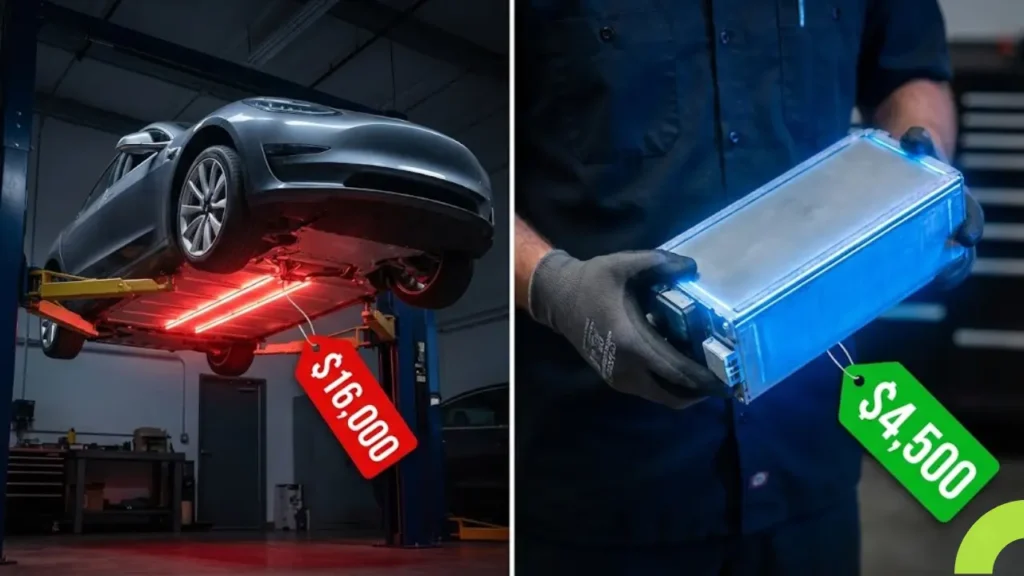
The “Third Way”: Repair Instead of Replace ($5,000)
If you are out of warranty and Tesla quotes you $16,000 for a new pack, don’t panic yet. You might not need a whole new battery.
A Tesla battery pack is made of thousands of small cells grouped into “Modules.” Often, only one module fails while the rest are healthy. Tesla Service Centers generally don’t repair modules; they just swap the whole pack. But Independent EV Garages do.
🔧 The Module Swap Hack
Specialized third-party shops (like Gruber Motor Company or local EV specialists) can open your pack, find the one bad module, and replace just that part.
- Official Tesla Cost: ~$15,000 (New Pack)
- Independent Repair Cost: ~$4,000 – $7,000 (Module Repair)
- Savings: ~$8,000+
Does Insurance Cover Battery Replacement?
This is the most critical distinction every owner must know. The answer depends on how the battery died.
Frequently Asked Questions (FAQs)
Surprisingly fast. Since the battery is bolted to the bottom of the chassis, a Tesla Service Center can swap it in 3 to 5 hours. However, waiting for the replacement part to arrive in stock can take 1-4 weeks.
Minimal impact. Extensive data shows that frequent Supercharging accelerates degradation only slightly compared to home charging. The bigger factor is leaving the battery at 100% or 0% charge for long periods.
It is recycled. Tesla batteries are 100% recyclable. The valuable metals (Lithium, Cobalt, Nickel) are extracted and used to make new batteries. You do not get to keep the old pack.
*For detailed charts on used EV battery health, check the data at Recurrent Auto Research.
A Tesla battery replacement is expensive ($13k-$20k), but it is a rare event.
With an 8-year warranty and a lifespan exceeding 200,000 miles, 95% of owners will sell their car long before the battery dies. Drive it, enjoy the savings, and stop worrying about the “what ifs.”
Estimates Only: Prices mentioned (Parts & Labor) are based on 2025-2026 market data and owner reports. Actual costs vary by location and vehicle condition.
Warranty Advice: Always consult your official Tesla warranty document or insurance provider for specific coverage details. GreenMount Motors is not affiliated with Tesla, Inc.
Pingback: How Long Do Tesla Batteries Last? (2026 Lifespan & Degradation Guide) - greenmountmotors.com