
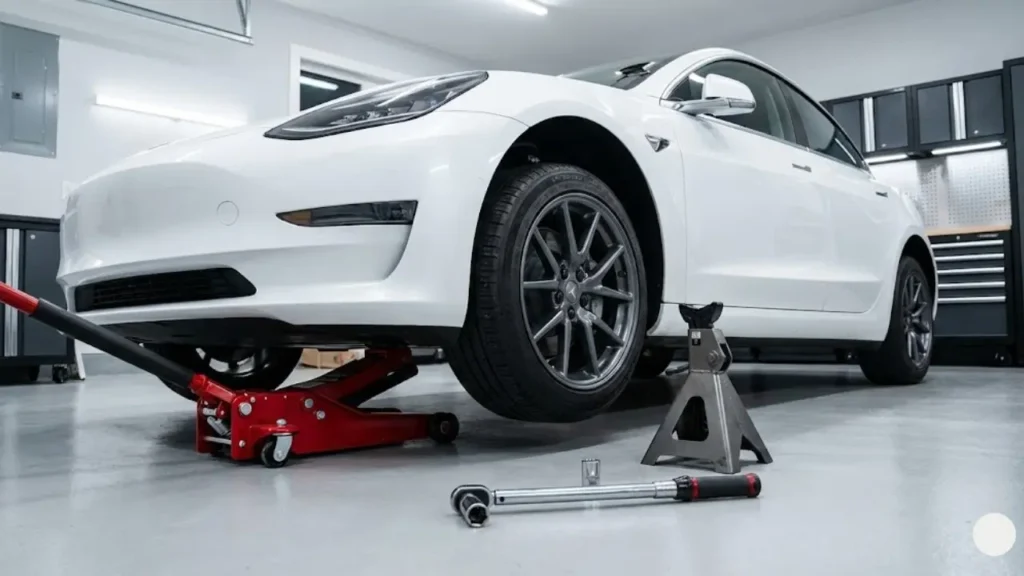
Lifting a Tesla is not like lifting a Honda Civic or a Ford F-150. If you place a hydraulic jack in the wrong spot on a regular car, you might dent a rocker panel. If you do it on a Tesla, you could puncture the $15,000 high-voltage battery.
Because the entire floor of the Model 3 and Model Y is a massive battery pack, there is very little room for error. The “safe zones” are small, specific, and require the right tools.
Whether you are rotating tires at home or just helping a friend with a flat, this guide will show you exactly where to place the jack to lift your EV safely.
Tesla vehicles have 4 specific Lift Points on the chassis frame rails (located just behind the front tires and just ahead of the rear tires).
- Step 1: Locate the circular hole under the side skirt.
- Step 2: Insert a Jack Pad (Puck) into the hole.
- Step 3: Place your floor jack under the puck and lift.
⛔ NEVER lift from the battery (the flat center area) or the side rails without a puck.

Green areas indicate the only safe lifting points. Red indicates the HV Battery.
Tool #1: Why You Need “Jack Pucks”
If you look under your Tesla, you will see four small holes in the frame. These are the lift points. However, they are recessed.
Standard car jacks have a flat metal cup. If you push that metal cup directly against the car’s frame, you risk hitting the side skirts or slipping and hitting the battery edge.
The Solution: Jack Pads (Pucks).
These are small rubber cylinders with a pin on top. The pin slides into the chassis hole, holding the puck in place. This creates a safe, buffered spacer between your metal jack and the car’s delicate body.
You don’t need expensive branded tools. A simple set of rubber lifting pucks from Amazon (usually under $25) works perfectly. Always keep a set in your trunk (frunk)—roadside assistance trucks often don’t carry them!
Do I Need “Jack Mode”? (Model 3 vs. Model S)
This is a common confusion. If you Google “how to jack up a Tesla,” you will see warnings about enabling Jack Mode.
For Model 3 & Model Y (Standard):
Most Model 3s and Ys have standard coil spring suspension. You do NOT need Jack Mode because there is no air suspension to damage.
For Model S & Model X (and some Model Y Performance):
If your car has Air Suspension, you MUST enable Jack Mode. If you don’t, the car will try to self-level while you are lifting it, which can damage the suspension system.
To check: Go to Controls > Suspension. If you don’t see this menu, you don’t have air suspension.
Step-by-Step: Lifting Your Tesla Safely
Ready to lift? Follow this exact sequence to ensure the car stays stable and the battery stays safe.
Note: If you are lifting the car to rotate your tires yourself (which saves money), make sure you know the specific directional pattern for EVs. Read our Complete Guide on EV Tire Rotation Patterns before you start loosening nuts.
Phase 1: Preparation
- Park on Level Ground: Never jack up a car on a slope. Concrete or asphalt is best.
- Loosen Lug Nuts (Slightly): While the car is still on the ground, use a breaker bar to break the tension on the lug nuts. Do not remove them yet—just turn them about 1/4 turn.
Phase 2: Positioning & Lifting
- Locate the Hole: Kneel down and find the small circular hole in the frame rail (refer to the diagram in Part 1).
- Insert the Puck: Take your rubber Jack Pad and push the pin directly into the chassis hole. It should hang there by itself (thanks to the O-ring friction).

- Align the Floor Jack: Roll your hydraulic floor jack under the car. Center the jack’s lifting cup perfectly under the rubber puck.
- Lift Slowly: Pump the jack handle. Watch closely as the jack cup makes contact with the puck. Ensure it doesn’t slip. Continue lifting until the tire is about 2 inches off the ground.
For the exact technical specifications and official warnings, you can refer to the Official Tesla Model 3 Lifting Procedure.
A hydraulic jack is for lifting, not holding. Seals can burst, and jacks can fail.
NEVER put any part of your body under the vehicle unless it is supported by a Jack Stand.
The “Jack Stand” Problem
Here is the tricky part about Teslas: Because the jack point is so small, the jack occupies the only safe spot to put a stand.
If you need to keep the car up for a long time (e.g., brake work), you have two options:
- The Quick Method: For simple tire changes, leave the jack engaged but slide a spare tire or jack stand under a suspension arm (control arm) strictly as a backup safety catch.
- The Pro Method: Buy specialized “JackPoint Jackstands” or “Rennstands” that allow you to lift and support from the same spot.
Phase 3: Lowering & Torquing (Do Not Skip)
Once your work (tire change or rotation) is done, simply reverse the process. But be careful—this is where most people forget the most important step: Torquing the nuts.
- Lower the Car: Gently release the hydraulic pressure. Remove the jack.
- Remove the Puck: CRITICAL! Do not forget to pull the rubber puck out of the frame rail. If you drive off with it inserted, it can fall out on the highway.
- Torque the Lug Nuts: Use a torque wrench to tighten the nuts in a star pattern.
Tesla Lug Nut Torque Specifications
Tesla requires a much higher torque setting than many gas cars. Do not guess.
| Model | Torque Spec (lb-ft) | Torque Spec (Nm) |
|---|---|---|
| Model 3 (All Years) | 129 lb-ft | 175 Nm |
| Model Y (All Years) | 129 lb-ft | 175 Nm |
Troubleshooting After Lifting
1. TPMS Warnings:
After rotating tires or changing a wheel, your car might display a tire pressure fault. This is normal. The sensors need to “re-learn” their positions.
If the light stays on after driving for 10 minutes, you may need to reset the system manually. Follow our guide on How to Fix Tesla Tire Pressure System Faults.
2. Need New Tires?
If you lifted your car and noticed the tread is worn down (EVs eat tires faster than gas cars), you need to choose the right replacements to avoid losing range. Check out our recommendations for the Best Tires for Tesla Model Y & Model 3 (2026).
Frequently Asked Questions
Do I really need jack pads for a Tesla?
Yes. The battery pack sits almost flush with the lifting points. Without a jack pad (puck) to create clearance, a standard floor jack saddle can crush the side skirt or, worse, puncture the high-voltage battery casing.
Does Model 3 have a Jack Mode?
No, the standard Model 3 and Model Y (with coil suspension) do not have or need a “Jack Mode.” This feature is only for Model S and X vehicles equipped with adaptive air suspension.
Where are the lift points on a Tesla Model Y?
The lift points are four specific holes located on the frame rails: two behind the front wheels and two in front of the rear wheels. Look for the small circular opening in the chassis metal.
⚠️ Disclaimer:
This guide is for educational purposes only. Lifting a vehicle carries inherent risks. GreenMountMotors assumes no liability for property damage or personal injury.
Always consult your official Tesla Owner’s Manual for the most up-to-date lifting procedures and torque specifications.
Pingback: Tesla Model 3 & Y Interior Rattles Fix: The Ultimate DIY Guide (2026) - greenmountmotors.com