
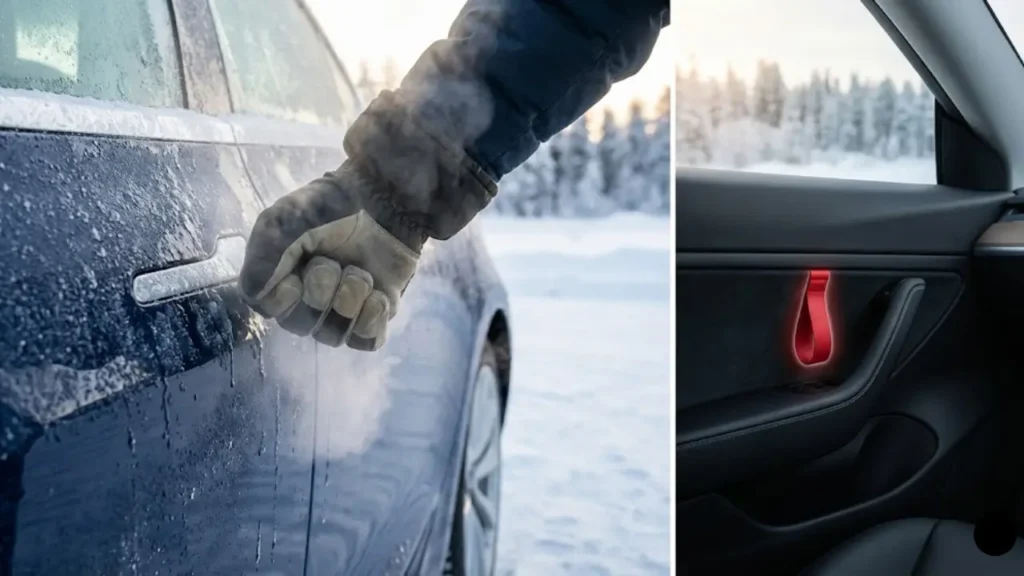
There is nothing quite as futuristic as walking up to your Tesla, expecting the door to seamlessly welcome you, and… nothing happens. You pull, you push, but the handle is dead.
It is not just inconvenient; it can be embarrassing. Whether you are stuck in a freezing parking lot with a Tesla door handle frozen shut, or staring at a Model S handle that refuses to present itself, the feeling of being “locked out” is stressful.
If your Tesla door handle is stuck, don’t panic. In this guide, we will break down the solutions for both the “Frozen” handles of the Model 3/Y and the “Broken” motorized gears of the Model S.
Note: If your door opens but the window behaves strangely (drops down or bounces back), check our guide on Tesla Window Calibration first, as the two systems are linked.
Step 1: Know Your Mechanism (Manual vs. Motorized)
Before you try to pry anything open (please don’t!), you must understand why it is stuck. Tesla uses two completely different handle designs:
- Model 3 & Model Y (The Pivot): These are purely mechanical. When you push the wide part, the thin part swings out. If these are stuck, it is usually due to ice buildup or debris jamming the hinge.
- Model S & Model X (The Presenter): These are motorized. They slide out automatically when you approach. If these fail to come out (Tesla door handle won’t present), it is usually an internal wire break or gear failure.
The Quick Diagnostic Test
Is it the weather or the car? Check the temperature.
Yes: It is 99% likely that ice has fused the handle to the body. Do not pull hard—you might snap the plastic. Proceed to Part 2 for the “Fist Bump” fix.
No: If it’s warm and the handle is dead, you have a mechanical or electrical failure. Proceed to Part 3.
Most searches for stuck handles happen during winter. Tesla actually has an official (and slightly violent-looking) method to fix this. In the next section, we will teach you the “Tesla Fist Bump” technique to break the ice without breaking your car.
The “Tesla Fist Bump” (Official Fix for Model 3/Y)
If you own a Model 3 or Model Y, your handles are flush with the body. When freezing rain hits, a sheet of ice covers the entire mechanism, gluing it shut.
Just as extreme cold impacts your battery efficiency—as detailed in our Real World EV Winter Range Test—it also stiffens the mechanical springs in your door.
To fix this, you don’t need a hairdryer. You need “Percussive Maintenance.” Tesla officially recommends applying force to break the ice.
- Remove Jewelry: Take off rings or watches to avoid scratching the paint.
- Make a Fist: Use the fleshy bottom part of your fist (like you are knocking on a door).
- Strike the Handle: Firmly bump the door handle area. Do not hit it so hard that you dent the metal, but use enough force to shatter the thin layer of ice.
- Press & Pull: Once the ice cracks, press the wide back part of the handle. It should now pivot open.
Never pour boiling water on a frozen handle. The thermal shock can shatter your window glass instantly. Also, that water will eventually cool down and freeze again, making the problem worse later.
The “Cheat Code”: Unlatch via App
If the fist bump doesn’t work, or if the handle is physically stuck but the electronics are fine, you can bypass the handle entirely.
In 2022, Tesla updated the mobile app with a feature specifically for this Tesla door handle frozen scenario.
- Open the Tesla App.
- Long-press one of the quick control icons to customize your menu.
- Drag the “Unlatch Door” icon to your main screen.
- Tap it. The driver’s door will mechanically pop open a few inches, allowing you to grab the edge of the metal and pull it open without touching the frozen handle.
But what if it’s not winter? What if you own a Model S and the handle is making a grinding noise but refusing to come out? That is a much more expensive problem. Let’s cover the Broken Gear Issue in the next section.
The Model S Nightmare: When “Auto-Present” Fails
If you drive a Model S (especially pre-2020 versions), the door handles are engineering marvels. They slide out automatically when you approach with the key fob. But this complexity comes at a cost.
When a Tesla door handle won’t present, it isn’t usually a software glitch. It is almost certainly a mechanical failure inside the door panel.
The 3 Main Symptoms:
- Grinding Noise: You hear the motor spinning, but the handle stays flush. This means the Paddle Gear has snapped.
- Dead Silence: No noise, no movement. This usually indicates a burnt-out motor or a blown fuse.
- The “Ghost” Pull: The handle comes out, but pulling it does nothing. This is a Microswitch Failure (wire fatigue).
The $2 Part vs. The $1,000 Bill
The most common failure point in older Model S units is a small metal component called the “Paddle Gear.” It costs about $5 to manufacture, but because it is buried deep inside the door assembly, labor costs are high.
If your handle is dead, you essentially have two options:
- Tesla Service Center: They typically replace the entire handle assembly (Generation 3 handles are more reliable). Cost: $800 – $1,200 per handle.
- DIY Repair Kit: You can buy a reinforced Tesla door handle repair kit online for $50-$100. However, this requires removing the door panel and glass window—a difficult 2-hour job.
If your driver’s door handle is broken, don’t climb through the passenger side yet. Use the Mobile App to unlock the car, or use the Key Fob’s trunk button.
As we discussed in our Lost Tesla Key Card Guide, having a backup entry method (like the App setup properly) is crucial for moments when hardware fails.
But let’s say the situation is even worse. You are inside the car, the power has failed (dead 12V battery), and the electronic button to open the door won’t work. You are trapped.
This is a safety-critical scenario. In the final section, we will show you the hidden Emergency Mechanical Release latches that every owner must know about.
Emergency: How to Open Doors Without Power
This is the most important section of this guide. Since Tesla doors are electronic, a dead 12V battery means the interior button won’t work. You need to know the location of the Emergency Mechanical Release.
Model 3 & Model Y (Front Doors)
Look at the window switches on the armrest. Just in front of them, there is a manual latch that sits flush with the plastic. Pull this latch up manually. The door will mechanically pop open.
Model 3 & Model Y (Rear Doors)
The rear doors are trickier. There is no visible latch.
In the bottom of the rear door pocket, there is a rubber mat.
1. Remove the rubber mat.
2. You will see a white plastic tab covering a slot.
3. Remove the tab and pull the cable underneath towards the center of the car.
Note: Educate your children about this mechanism if they sit in the back.
Frequently Asked Questions
Yes. If your car is under the Basic Vehicle Limited Warranty (4 years or 50,000 miles), door handle repairs—including the notorious Model S gear failure—are covered for free. Outside of warranty, expect to pay $300-$1,000 depending on the model.
2. Should I use WD-40 on a stuck handle?Avoid standard WD-40. It is oil-based and attracts dust and dirt, which will eventually turn into a gummy paste and jam the handle worse. Instead, use a Silicone Spray or Graphite Lubricant, which withstands freezing temperatures without attracting grime.
3. Can a car wash break my handles?On older Model S units, high-pressure water jets aimed directly at the handle can force water inside and damage the microswitches. For Model 3/Y, the risk is low, but water can freeze inside the handle in winter immediately after a wash.
For more official troubleshooting steps, refer to the Tesla Official Do-It-Yourself Guide (Doors Section).
Disclaimer: GreenMount Motors is an independent guide. We are not affiliated with Tesla, Inc. Attempting DIY repairs on Model S handles involves removing glass and may void your warranty if damage occurs. Proceed with caution.
Pingback: Tesla 12V Battery Warning: Can You Drive? Cost & Replacement Guide (2026) - greenmountmotors.com
Pingback: 10 Common Tesla Model 3 Problems (2026): Reliability & Fixes Guide - greenmountmotors.com