
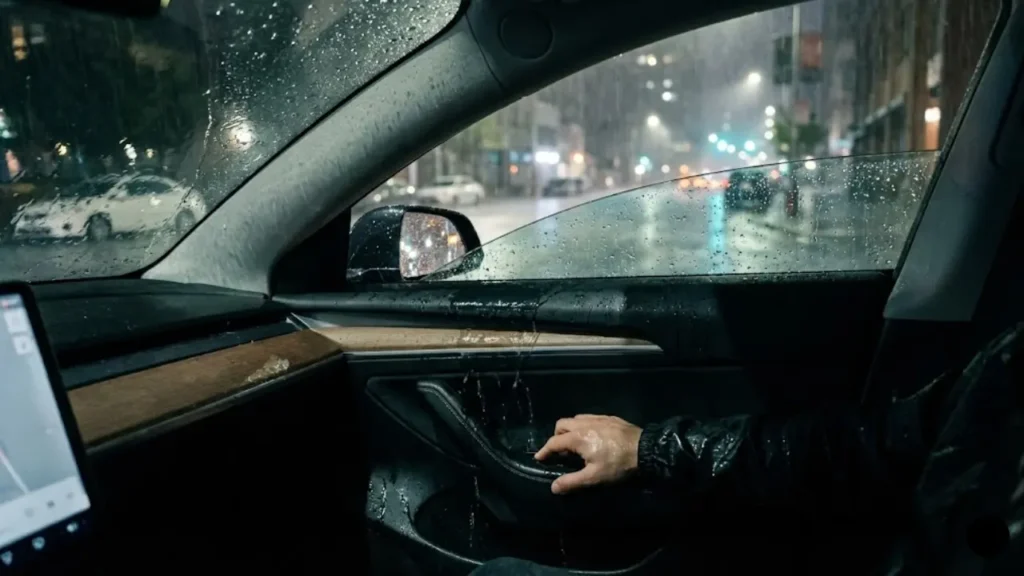
Imagine this: You are driving down the highway, or perhaps you just parked your car as a rainstorm begins. You pull the switch to close your window. The glass slides up perfectly, hits the top, and then—immediately drops back down halfway.
You try again. It goes up, hits the seal, and bounces back down. Panic sets in. Is the motor broken? Is the regulator fried? Will my interior get soaked?
If you are facing this Tesla window bounce back fix scenario, take a deep breath. In 95% of cases, your hardware is fine. Your car is just “confused.”
In this guide, we will walk you through the simple Tesla window calibration process that fixes this issue in under 2 minutes—no tools required.
The “Ghost” Window: Why Does It Happen?
To understand the fix, you first need to understand the design. Unlike traditional cars, most Teslas (specifically the Model 3 and Model Y) feature frameless windows.
As we noted in our detailed Tesla Model 3 vs Model Y comparison, both vehicles lack a metal frame around the glass. This looks sleek, but it requires the window to perform a “short drop” every time you open the door to clear the chrome trim. Because the window is constantly moving up and down slightly, the software can sometimes lose track of exactly where “Top” and “Bottom” are.
The Culprit: “Anti-Pinch” Protection
The reason your Tesla window rolls down halfway isn’t because it likes fresh air. It is a safety feature saving your fingers.
Every modern Tesla window has a resistance sensor. If the glass encounters any friction while going up (like a child’s neck or a finger), the motor detects a spike in voltage and immediately reverses direction to prevent injury.
When calibration is lost, the window might think the rubber seal at the top of the door frame is an obstacle. It hits the seal, thinks “Obstruction Detected!”, and triggers the safety reverse. This is why it bounces back down.
Essentially, your car is being too safe. It thinks the door frame is a finger.
So, how do we tell the computer, “Hey, that’s just the roof, not a hand”? We have to teach it the limits again. In the next section, we will guide you through the 2-Minute Calibration Cycle.
Reset vs. Calibration: Know the Difference
Before we touch the buttons, let’s clear up a common misconception. Many forums suggest performing a “Scroll Wheel Reboot” or wiping the car’s software to fix window glitches.
This is unnecessary overkill. As explained in our Guide to Factory Resetting Your Tesla, a full system wipe is for selling the car or fixing deep software bugs. For a window that won’t close, you just need a targeted “Calibration Cycle” which focuses solely on the door module.
The 2-Minute Fix (Step-by-Step)
This procedure works for the Model 3, Model Y, Model S, and Model X. You don’t need any tools, just your finger.
- Close the Door: This is critical. Sit inside the car and close the door completely. The calibration will fail if the door is open.
- Roll Down: Press the window switch down until the window is fully open. Once it hits the bottom, keep holding the switch down for 5-10 seconds.
- Roll Up: Pull the switch up until the window is fully closed. Once it hits the top, keep holding the switch up for 5-10 seconds.
- Repeat (Optional): For best results, repeat the Down/Up cycle one more time.
- Test It: Release the switch and try the “One-Touch” auto-up feature. The window should now close smoothly without bouncing back.
Did it work?
If the window stays up, congratulations! You have successfully retaught the computer where the “Top” seal is located.
What If It Still Bounces Back?
If you performed the steps above perfectly and the Tesla window bounce back fix didn’t work, or if the window behaves erratically (stuttering while moving), you might have a hardware interference issue.
Surprisingly, the culprit is often a cheap accessory you bought months ago: The Puddle Light.
In the next section, we will reveal how a $15 aftermarket light can short-circuit your $50,000 car’s window logic—a pro tip most owners miss.
The Sneaky Saboteur: Aftermarket Puddle Lights
This is a “Pro Tip” you won’t find in the owner’s manual. Have you recently installed those cool LED lights that project the Tesla “T” logo on the ground when you open the door?
If so, they are likely the problem.
Here is the technical reason: The window motor and the puddle light share the same wiring harness within the door controller. Many cheap aftermarket lights ($15–$20 on Amazon) lack proper electrical resistance. As they age, they start to leak voltage or short out.
This confuses the door controller. The car thinks the door is being opened (because the light circuit is acting up), so it drops the window slightly to clear the trim. Then it realizes the latch is closed, so it tries to push it up. This results in the window “dancing” or refusing to stay up.
If you have aftermarket lights installed:
1. Use a flathead screwdriver to pop them out.
2. Re-install the original OEM lights that came with the car.
3. Perform the calibration cycle again.
In 8 out of 10 cases, this instantly fixes the Tesla window not closing issue.
Winter Woes: Ice vs. Pinch Protection
If your lights are stock, look at the weather. Cold temperatures are the enemy of frameless windows.
Ice buildup at the bottom of the window seal creates friction. As the window tries to roll up, the motor feels this drag. Remember the “Anti-Pinch” feature? The car interprets this ice friction as a finger and reverses the window.
We discussed how cold weather impacts the battery in our Real World EV Winter Test, but it impacts the bodywork too. To prevent this:
- Pre-condition: Always turn on the climate control 15 minutes before driving to melt the seals.
- Silicone Lubricant: Use a product like Gummi Pflege on the rubber seals to keep them soft and prevent sticking in freezing temps.
But what if you have calibrated the window, checked the lights, melted the ice, and it still fails? Sometimes, the hardware actually is broken. In the final section, we will discuss Regulator Failure and answer common FAQs.
When Calibration Fails: The Dead Regulator
If you have tried the calibration reset and removed any aftermarket lights, but the window still refuses to close—or worse, makes a nasty “crunching” or “grinding” sound—you likely have a mechanical failure.
The part responsible for moving the glass is called the Window Regulator. In early Model 3s (2017-2019), these were known to fail due to moisture ingress.
Signs of a Broken Regulator:
- The window slides down but won’t go up at all.
- You hear a motor whirring sound, but the glass doesn’t move (the cable has snapped).
- The glass feels loose or wobbly in the track.
In this case, no amount of button holding will fix it. You need to schedule a service appointment via the Tesla App.
Frequently Asked Questions
No. Holding the two scroll wheels reboots the infotainment screen (MCU). It does not reset the individual door control modules. You must use the calibration method (holding the window switch) described in Step 2.
2. How much does a window regulator repair cost?If you are out of warranty (Basic Vehicle Warranty: 4 years/50,000 miles), a window regulator replacement typically costs between $350 and $550 at a Tesla Service Center, depending on labor rates in your area.
3. Can I use “Service Mode” to calibrate?Yes, advanced users can enter Service Mode via the screen to run a “Window Calibration” diagnostic. However, the manual button-hold method is faster and achieves the exact same result for the end user.
For more official troubleshooting steps, refer to the Tesla Official Do-It-Yourself Guide (Windows Section).
Disclaimer: GreenMount Motors provides DIY guides for informational purposes. If you are unsure about performing these steps, or if the window makes grinding noises, please contact Tesla Service immediately.
Pingback: Tesla Door Handle Stuck? The "Fist Bump" Fix & Emergency Open Guide (2026) - greenmountmotors.com
Pingback: Tesla 12V Battery Warning: Can You Drive? Cost & Replacement Guide (2026) - greenmountmotors.com
Pingback: Tesla Wind Noise Reduction Kit Review: Snake Oil or Worth It? (2026) - greenmountmotors.com