
The Tesla Model Y isn’t just an electric car; it is currently the best-selling vehicle on the planet, surpassing even the Toyota Corolla. Families love it for the space, the tech, and the safety. But popularity doesn’t mean perfection.
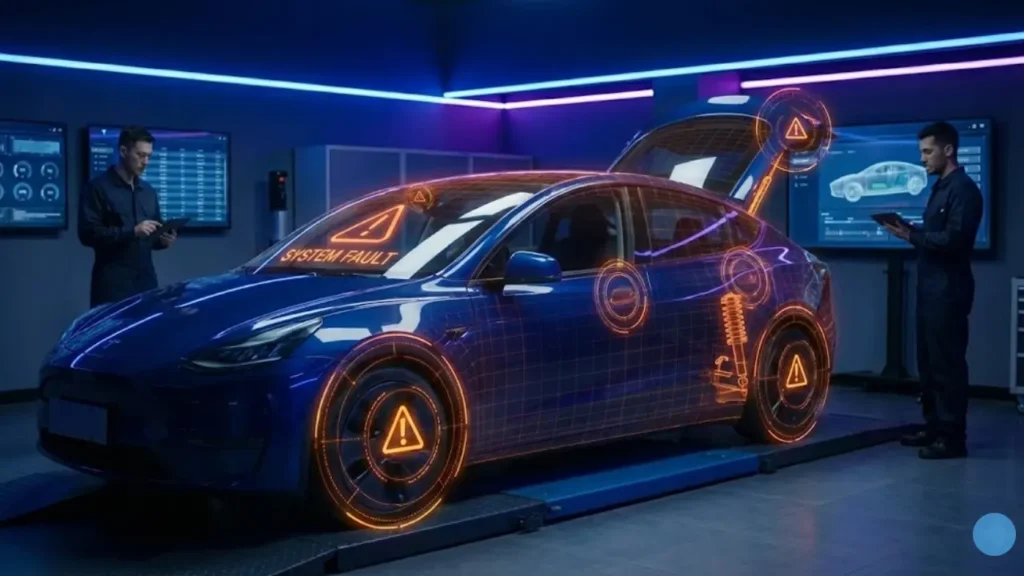
If you are looking to buy one in 2026, or if you already have one in your driveway, you might be noticing some quirks. From a stiff ride that spills your coffee to a rear trunk that has a mind of its own, the Model Y has a specific set of known faults.
In this guide, we break down the top Tesla Model Y common issues, separate the myths from the deal-breakers, and provide you with the DIY fixes you need.
Shopping Advice: Many of these issues are shared with the Model 3, but the SUV form factor introduces unique challenges. If you are still deciding between the sedan and the crossover, check our detailed comparison on Tesla Model 3 vs. Model Y: Which One Fits Your Life?
1. The “Stiff” Suspension Complaint
By far, the #1 complaint regarding Tesla Model Y suspension comfort problems is that it rides “too hard.” Unlike a Lexus or an Audi Q5 that floats over bumps, the Model Y was designed with a sporty, tight chassis.
The Reality Check:
- Pre-2023 Models: If you are buying a used 2020-2022 Model Y, be warned. The suspension is notoriously stiff. You will feel every pothole, crack, and pebble on the road. Passengers in the rear seats often complain of being bounced around.
- 2023-2026 Models: Tesla silently updated the manufacturing line with a new “Comfort Suspension.” It is significantly softer and more compliant, though still sportier than most gas SUVs.
2. Build Quality: The Rear Hatch Alignment
While Tesla has improved massively, the Model Y’s complex rear shape (the “Fastback” design) makes aligning the massive trunk lid difficult at the factory.
The Checklist: When inspecting a Model Y, look closely at the gap where the trunk meets the roof glass and the tail lights. Uneven gaps are cosmetic, but if the misalignment is severe, it can cause:
- Water leaks into the trunk during heavy rain.
- Scratches on the bumper paint where the lid rubs against it.
- Difficulty in latching (which leads to the dreaded “3 Beeps” error).
3. “Curb Rash” Magnet (Rim Damage)
This is not a manufacturing defect, but a design choice that frustrates almost every new owner. The Model Y’s stunning “Uberturbine” and “Induction” wheels are designed to be aerodynamic.
The Problem: The metal rim protrudes further out than the rubber tire sidewall. This means if you brush against a curb while parking, the tire won’t protect you. Metal meets concrete instantly, resulting in ugly scratches (Curb Rash).
The Fix: Be extremely careful when parallel parking, or invest in aftermarket “Rim Protectors” that clip onto the wheel edge.
4. The “Haunted” Power Trunk
The Model Y features a massive, heavy rear hatch. Unlike the lighter trunk of a Model 3, this powered liftgate relies heavily on precise strut calibration. And frankly, it is prone to temper tantrums.
The Symptoms: You press the close button, the hatch lowers halfway, stops, and reverses back up while beeping aggressively at you. This is the “Pinch Protection” sensor acting too sensitive, thinking a ghost is blocking the latch.
Is your trunk refusing to latch? Do NOT force it down, or you might break the motor. We have a specific guide on how to reset the sensors and fix the “3 Beeps” error. Read here: Tesla Trunk Won’t Close? How to Fix the 3 Beeps.
5. The “No Sensor” Parking Anxiety
If you drove a car built before 2023, you are used to the Beep-Beep-Beep of ultrasonic sensors (USS) when parking. Tesla removed these physical sensors in late 2022 to save costs, relying entirely on cameras (Tesla Vision).
The Problem: Tesla Vision Park Assist problems are a major complaint for Model Y owners. Since there is no camera on the front bumper bumper (blind spot), the car “guesses” how close you are to the wall. It often screams “STOP!” when you still have 2 feet of space, or worse, stays silent when you are inches away.
Seeing the message “Park Assist Unavailable”? This is a common glitch with the vision system. Check out our troubleshooting guide on How to Fix Tesla Park Assist Unavailable to restore your distance lines.
6. Phantom Braking on Autopilot
The Model Y is a fantastic road trip vehicle, but “Phantom Braking” remains its Achilles’ heel. This happens when the car is cruising on Autopilot at 70 mph and suddenly slams on the brakes because it mistook a bridge shadow or an oncoming truck for a collision risk.
While software updates in 2025/2026 have smoothed this out significantly, it still happens on two-lane highways. It’s not just annoying; it can be dangerous if someone is tailgating you.
7. Rear Seat Rattles
The Model Y’s rear seats are foldable to create a massive cargo area. However, the latch mechanism that holds the seats upright has a design flaw: metal-on-metal contact.
Over rough roads, this creates a constant click-click-click noise right behind the driver’s ear. The community fix? Wrapping a small piece of electrical tape or felt around the metal striker hook usually solves it instantly.
8. The Heat Pump Failure (Winter Nightmare)
Unlike early Teslas that used resistive heating (like a giant toaster), the Model Y uses an advanced “Heat Pump” to warm the cabin efficiently. It is a marvel of engineering, until it stops working.
The Issue: In extreme cold (below -15°C / 5°F), early sensors in the heat pump manifold would fail, causing the climate control to shut down completely. This left drivers stranded in freezing temperatures with only “Cold Air” blowing from the vents.
The Fix: Tesla has issued multiple software updates to recalibrate these sensors, and newer 2024-2026 builds have redesigned valves. However, if you are buying a used 2020-2021 Model Y, ensure the “Supermanifold” has been inspected or replaced under warranty.
9. The “Dirty Sock” Air Conditioner Smell
Just like its smaller sibling (the Model 3), the Model Y suffers from poor drainage in the air intake area. Moisture gets trapped near the evaporator, creating a breeding ground for mold and bacteria.
The result? A blast of vinegar-like stench every time you start the car in humid weather.
Changing the filters alone won’t fix it; you need to clean the coils. We have a complete DIY walkthrough on How to Remove the Vinegar Smell from Your Tesla AC.
10. Heavy Car, Short Tire Life
Tesla Model Y tire wear is often a shock to new EV owners. While the car requires almost no maintenance, it eats tires for breakfast.
Why?
- Weight: The Model Y weighs over 4,400 lbs (due to the battery).
- Torque: The electric motors deliver instant power to the wheels, increasing friction.
- Alignment: The factory camber settings are aggressive for handling, which can wear the inner edges of tires.
Expect to replace stock tires every 20,000 to 25,000 miles. To make them last longer, read our guide on Why EV Tires Wear Out Fast & How to Extend Their Life.
11. High Voltage Battery Anxiety
The biggest fear of any EV buyer: “What if the battery dies?”
The good news is that catastrophic battery failure on the Model Y is extremely rare. The structural battery pack (4680 cells) and the older 2170 packs are designed to last 300,000 to 500,000 miles.
However, degradation (loss of range) is real. Most owners see a 5-10% drop in the first two years, which then stabilizes. Curious about the data? Check our analysis on Real World Tesla Battery Longevity to see how many years you can actually expect.
The Verdict: Is the Model Y Reliable?
Reading about suspension stiffness and phantom braking might make you hesitate. But context is everything. No car is perfect, and the Model Y’s issues are rarely mechanical “engine failures” that leave you stranded.
The Safety Factor:
While the paint might chip, the Model Y is one of the safest vehicles ever tested. It achieved the highest possible rating from the Insurance Institute for Highway Safety.
If safety is your priority for your family, verify the crash test results yourself on the official IIHS Model Y Safety Ratings page.
Quick Summary: Pros vs. Cons
| ✅ The Good | ❌ The Bad |
|---|---|
| Unmatched Cargo Space | Stiff Suspension (Pre-2023) |
| Supercharger Network | Vision Park Assist (No Sensors) |
| Low Maintenance Costs | Fast Tire Wear |
| Top-Tier Safety Ratings | Rear Hatch Misalignment |
Buying Used? Always check the VIN. Tesla has issued recalls for steering knuckles and suspension bolts on older units. Use the NHTSA Recall Lookup Tool before signing any paperwork.
Frequently Asked Questions
Yes. In late 2022/early 2023, Tesla introduced a “Comfort Suspension” upgrade with softer springs and dampers. If you test drive a 2021 model vs. a 2026 model, the difference in ride quality is night and day.
2. What is the most expensive repair on a Model Y?Outside of a battery replacement (which is rare), the most expensive common repairs are the Heat Pump replacement ($3,000+) and suspension control arm work ($1,500+), if out of warranty.
3. Is the Model Y better than Model 3 for reliability?They share 75% of the same parts, so reliability is similar. However, the Model Y has more issues with the rear powered trunk and rear seat rattles due to its hatchback design, while the Model 3 is simpler.