
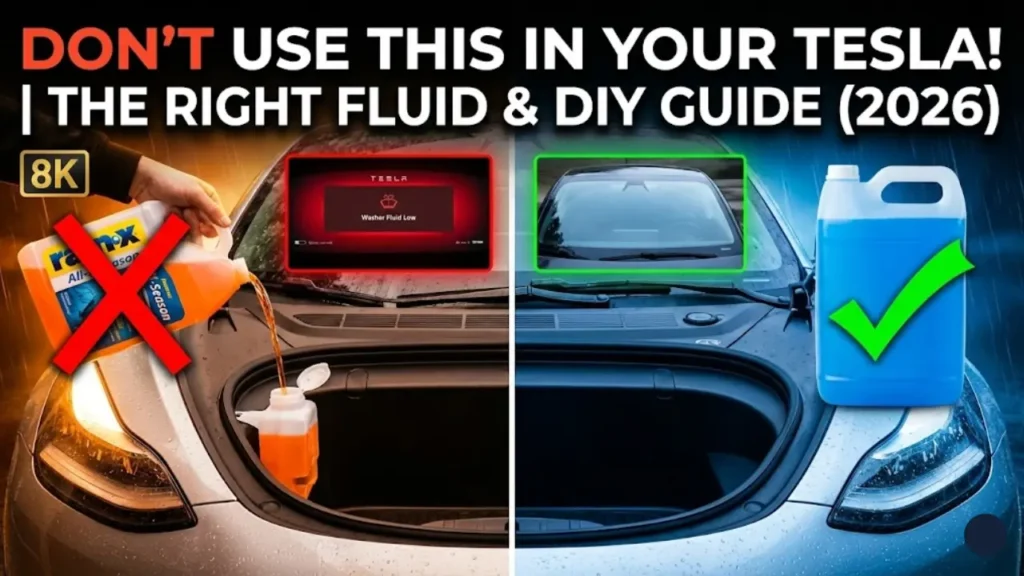
You pop the frunk, unscrew the blue cap, and pour in a fresh gallon of fluid until it reaches the brim. You close everything up, get back into the driver’s seat, expecting the alert to disappear. But it stares right back at you:
“Washer Fluid Low. Please refill.”
It is one of the most frustrating minor glitches in the Tesla ecosystem. The tank is physically full, yet the car is convinced it is empty. Before you schedule a service appointment for a broken sensor, you need to know that 90% of the time, the sensor isn’t broken—it is just confused.
In this guide, we will deep dive into everything you need to know about Tesla windshield washer fluid: which types to avoid (looking at you, Rain-X), how to reset a glitchy sensor at home, and the best fluids to use for clear visibility.
Why Tesla Sensors Are Different (The Science)
To understand why your Tesla is lying to you, you have to understand how it “sees” the fluid. In a traditional Toyota or Ford, there is a simple mechanical float inside the tank. When the liquid level drops, the plastic float drops, completing a circuit and turning on the light. It is simple, cheap, and works with any liquid.
Tesla, being Tesla, over-engineered this.
Instead of a mechanical float, modern Tesla Model 3 and Model Y vehicles often use Electrical Conductivity Sensors (Capacitance-based sensors). These sensors do not measure “volume”; they measure the ability of the fluid to conduct a tiny electrical current between two metal prongs.
The Conductivity Trap
Here is the catch: For the sensor to work, the Tesla windshield washer fluid must contain enough water and alcohol to conduct electricity. If you use a fluid that coats the sensor in oil, wax, or silicone (common in water-repellent additives), the sensor gets insulated.
Once insulated, the sensor thinks it is surrounded by air (which doesn’t conduct electricity), triggering the permanent “Low Fluid” warning, even if the tank is overflowing.
Note: Sometimes, sensor glitches aren’t caused by the fluid itself, but by voltage fluctuations from a dying auxiliary battery. If you are seeing multiple random errors alongside the washer fluid warning, check our guide on the Tesla 12V Battery Warning to rule out power issues first.
Quick Diagnostic: Leak vs. Sensor Error
Before we blame the fluid type, let’s make sure you don’t have an actual physical problem.
Fill the tank to the top. Park the car on a dry surface for 30 minutes. Check the ground under the front bumper (usually the passenger side for LHD cars).
Puddle Found? You likely have a cracked reservoir or a disconnected hose (common after freezing winters).
Dry Ground? Your tank is holding water perfectly. The issue is purely with the sensor reading the specific Tesla windshield washer fluid you used.
If your ground is dry but the warning persists, you have likely fallen victim to the “Rain-X Bug.” In the next section, we will reveal the specific brands that cause this issue and the one cheap fluid that Tesla actually recommends.
The Villain: Why “Water Repellent” Fluids Fail
If you search forums, you will find thousands of owners asking: “Can I use Rain-X in my Tesla?”
The short answer is: Avoid it. specifically the orange “All-Season” or “Water Repellent” versions.
Here is why. Brands like Rain-X, Prestone Bug Wash, or other “premium” fluids contain silicones, waxes, or polymers designed to make rainwater bead up and fly off your windshield. While this is great for visibility, it is terrible for your Tesla’s sensors.
Over time, these additives form a thin, invisible film over the metal prongs of the conductivity sensor inside the tank. This film acts as an electrical insulator. The result? The sensor can no longer conduct electricity through the fluid, so the computer assumes the tank is bone dry.
Tesla explicitly warns against this in the manual: “Do not add formulated water repellents or bug wash… these fluids can cause streaking, smearing, and squeaking or other noises.”
You can verify this directly in the Tesla Model 3 Owner’s Manual (Search: “Windshield Wiper Fluid”).
The Hero: The Cheap Blue Stuff
So, what is the best washer fluid for Tesla Model 3 or Model Y? Surprisingly, the cheaper, the better.
The standard, boring Blue Washer Fluid found at gas stations or Walmart (usually priced around $3-$4) is perfect. It typically contains just water, methanol (to prevent freezing), and blue dye.
- High Conductivity: It conducts electricity well, keeping the sensor happy.
- No Residue: It doesn’t leave wax on the sensor prongs.
- Freeze Protection: It works in winter without clogging the system.
Speaking of winter, choosing the right fluid rating is critical. Just as cold weather affects your battery range—as we detailed in our Real World EV Winter Range Test—it can also freeze your washer lines if you use summer fluid in January. Always check the temperature rating (e.g., -20°F) on the bottle.
Fluid Capacity: How Much Does It Hold?
One common annoyance is buying a gallon jug and realizing it doesn’t quite fit.
| Tesla Model 3 Capacity | ~3.2 Liters (0.85 Gallons) |
| Tesla Model Y Capacity | ~4.5 Liters (1.2 Gallons) |
Note for Model 3 Owners: Since the tank holds less than a standard US gallon (3.78L), you will always have a little bit left in the jug. Don’t try to force it, or it will spill into the frunk area.
But wait—what if you already filled it with Rain-X and the warning light is stuck on? Do you need to replace the sensor? Not necessarily. In the next section, we will show you a DIY “Hot Flush” trick to clean the sensor without removing any parts.
How to Fix the Sensor Without a Service Visit
So, you used the wrong fluid, and now the “Low Fluid” warning won’t go away. Do you need a new sensor? Probably not. You just need to clean the wax off the existing one.
Here is the proven DIY “Hot Flush” method that has saved thousands of Tesla owners from a service bill.
Step 1: Drain the Tank
You need to get the “bad” fluid out. You can do this in two ways:
- The Siphon Method (Recommended): Use a cheap manual siphon pump (from Amazon or an auto parts store) to suck the fluid out. This is the fastest way.
- The Spray Method: Hold the mist button on the stalk. Warning: Do not hold it continuously for more than 10-15 seconds at a time. Let the pump cool down for a minute between sprays to avoid burning out the motor.
Step 2: The “Sensor Cleaner” Mix
Once empty, don’t just refill it with blue fluid yet. You need to strip the waxy coating off the sensor. Create this mix:
- 90% Warm Distilled Water: Heat it lightly (not boiling, just warm to the touch). Warm water dissolves wax better.
- 10% Isopropyl Alcohol (Rubbing Alcohol): This breaks down the silicone/oil film.
- Optional: 1-2 drops of basic dish soap (like Dawn) to cut through grease.
Do NOT use: Vinegar (acid damages internal seals) or Bleach (toxic fumes and pump damage).
Step 3: The “Slosh” Drive
Pour the warm mix into the tank. Now, drive the car for 15-20 minutes. Go over some speed bumps or take some sharp turns. The agitation helps the alcohol mix scrub the sensor prongs inside the tank.
After the drive, spray this mix out completely and refill with standard blue fluid. The warning should disappear instantly.
Maintaining clear visibility is critical for safety. While you are working on your wipers, it is a good time to ensure your side windows are sealing correctly too. A window that doesn’t close fully allows moisture in, which can fog up your glass. Check our guide on Tesla Window Calibration to ensure your entire visibility system is 100%.
If this method fails after 2 tries, the sensor might be physically defective. But for most, this “Hot Flush” is the magic fix. In the final section, we will answer common FAQs and give you a winter survival tip.
Winter Survival: Don’t Let It Freeze!
A common mistake new EV owners make is using “Summer Fluid” (bug wash) year-round. In a combustion engine car, the engine heat keeps the washer lines warm. In a Tesla, there is no engine under the hood.
If you use fluid rated for 32°F (0°C) and the temperature drops to 20°F (-6°C), the fluid will freeze inside the lines and the tiny nozzle sprayers. Worse, as water expands when it freezes, it can crack your washer fluid pump or reservoir.
Pro Tip: As winter approaches, drain your summer fluid and switch to a “Winter Mix” rated for at least -20°F (-30°C). Just make sure it is the blue type, not the orange rain-repellent type.
Frequently Asked Questions
No. Tap water contains minerals (calcium and lime) that will clog the tiny spray nozzles over time and leave hard water spots on your glass. Always use distilled water or formulated washer fluid.
2. Is there a reset button for the sensor?No, there is no software button to reset the “Washer Fluid Low” warning. The system relies entirely on live data from the conductivity sensor. The only way to “reset” it is to clean the sensor using the method described in Step 3.
3. What if the warning still won’t go away?If you have flushed the tank with warm water and alcohol and the light is still on, the sensor unit itself may have failed or disconnected. You will need to schedule a mobile service appointment to replace the fluid level sensor.
While you are maintaining your visibility system, check if your blades need replacing too using the Tesla Official Guide: Wiper Blade Replacement.
Disclaimer: GreenMount Motors is an independent guide. We are not affiliated with Tesla, Inc. Recommendations are based on community experience and owner’s manuals.